

Acoustic panels do one job well: they soak up sound that would otherwise bounce around the room you are in. That cuts echo and reverberation, so your voice sounds clearer on calls and recordings, and a hard-surfaced room stops sounding like a bathroom.
What they do not do is soundproof. If your problem is a neighbour’s television, traffic or a flatmate’s calls coming through the wall, panels on your side of that wall will barely change it. That needs sealing gaps and adding mass to walls, doors and windows, which is building work rather than decoration.
So the first question is which problem you have: sound inside the room (echo, a boomy voice, a ringing tone when you clap) or sound coming in. This page is about the first one: what panels actually do, how to read their test numbers, how much wall to cover and where, and the one safety question that really matters.
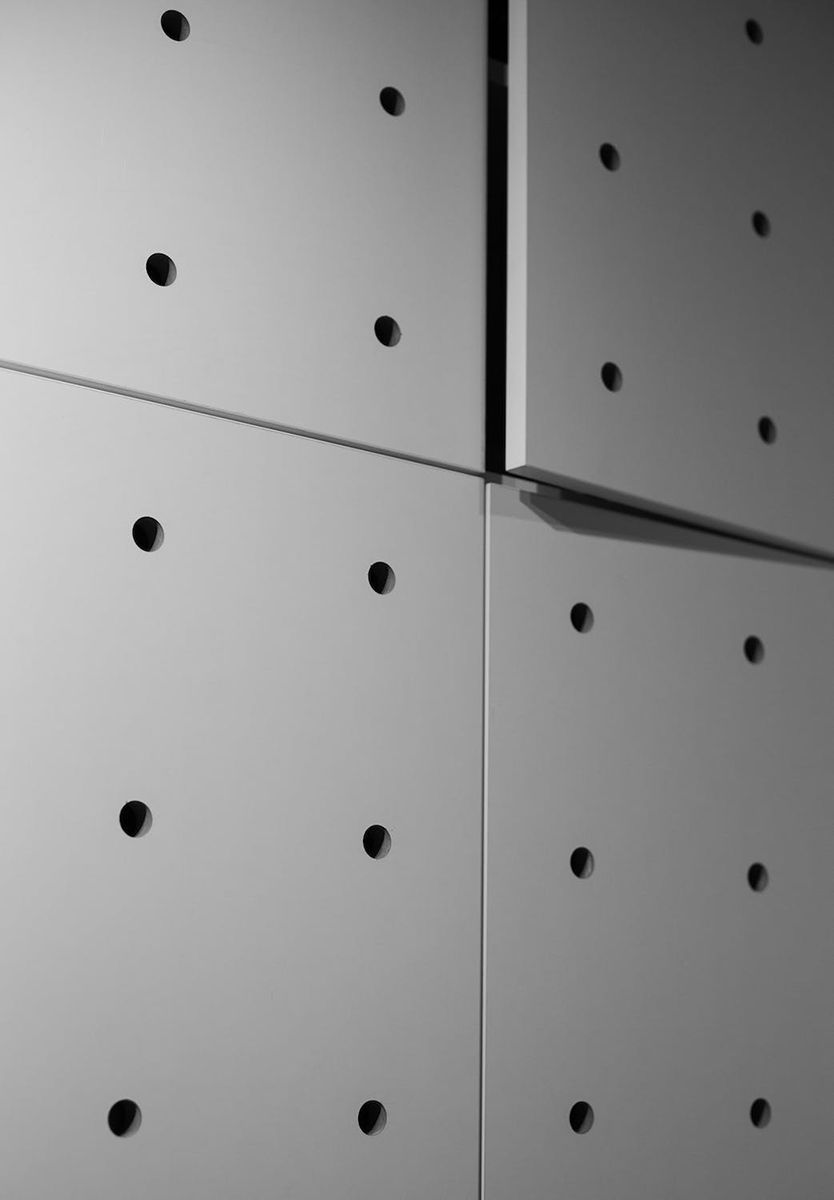
Absorbing sound is not the same as blocking it
The US General Services Administration’s office acoustics guide, Sound Matters, sums up noise control as the “ABC’s”: Absorb, Block, Cover. Panels belong to the first group only. The guide rates them by their noise reduction coefficient (NRC), a measure of absorption, and rates walls and partitions separately by sound transmission class (STC), a measure of how well a barrier stops sound passing between two spaces. It also warns that a closed door does not guarantee a private conversation, because sound leaks around doors, through walls, through the ceiling void and through ducting.
Inside a room, the thing panels change is reverberation time: the time it takes for a sound to fall by 60 decibels after it stops. As the HyperPhysics reference at Georgia State University explains, it depends on how absorbent the room’s surfaces are and on the room’s volume, which is why “You won’t get a long reverberation time with a small room.” It suggests a classroom should be less than a second and that a recording studio should keep reverberation to a minimum for clear recordings.
A small home office with bare walls, a desk and a hard floor still has very little to absorb anything, which is what people notice when they start recording. Kirsti Lang, who works from a home office in Cape Town, put it this way: “I probably need to figure out some sort of soundproofing so I can record without all the echo… next on the list?” Echo is exactly the problem panels fix, even though the word people reach for is “soundproofing”.
How to read NRC and absorption coefficients
An absorption coefficient is the share of sound energy a material absorbs at a given frequency, from 0 (reflects everything) upwards. The figures below were measured to the ASTM C423 test method. The NRC is a single-number summary: the GSA guide defines it as the average of the coefficients at 250, 500, 1000 and 2000 Hz, rounded to the nearest 0.05.
That averaging hides what happens at the bottom of the range. Owens Corning’s data sheet for its 703 fibreglass board, a semi-rigid board it lists for use on walls and ceilings, shows it clearly:
| 703 board, unfaced | 125 Hz | 250 Hz | 500 Hz | 1000 Hz | 2000 Hz | NRC |
|---|---|---|---|---|---|---|
| 1-inch (25 mm) | 0.05 | 0.26 | 0.63 | 0.88 | 0.97 | 0.70 |
| 2-inch (51 mm) | 0.15 | 0.71 | 1.14 | 1.16 | 1.02 | 1.00 |
| 4-inch (100 mm) | 0.56 | 1.26 | 1.22 | 1.11 | 1.07 | 1.15 |
Three things follow from those numbers. First, a 1-inch panel with a respectable NRC of 0.70 absorbs almost nothing at 125 Hz (0.05), so it tames the harsh, ringing part of a room but leaves the low boom of a deep voice or a subwoofer alone. Going to 4 inches lifts the 125 Hz figure to 0.56. Second, NRC values above 1.00 do appear in published lab data, as the table shows, so a product claiming 1.05 is not impossible; compare full frequency tables rather than headline numbers. Third, the facing matters: the same sheet lists 1-inch 703 with a foil (FRK) facing at 0.21 at 4000 Hz, against 0.94 for the unfaced board, so a panel with a hard or foil surface will not behave like bare fibre wrapped in fabric.
If you are buying rather than building, ask for this kind of table. Commercial suppliers usually have one: Queensland supplier Acoustics by Specfurn, for instance, says its professional acoustic panels are “independently tested to achieve a Noise Reduction Coefficient (NRC) value of up to 1.05”. A product page that gives no test standard and no figures at all tells you nothing about how much it will absorb.
The same logic explains why rugs and blankets help a little but rarely enough on their own: they are thin, so like the 1-inch board they work mostly at higher frequencies. Lisa Martinovská, a product designer in Prague, dropped her plan for wall panels and took that route: “Instead, I bought the thickest and fluffiest rug you can possibly find online so that there is at least some soundproofing.” In his small music room in northern Norway, Joakim Nilsen says of his carpet that ‘it does help with acoustics’, although he put it down for warmth on a bare concrete floor: “It was all about comfort and aesthetics”.
How much to cover, and where
There is no single right amount for a home office, but the GSA guide gives concrete targets for offices that are a useful starting point. For a private office it calls for absorption of NRC 0.8 minimum on 25% of walls. For teleconference rooms, which is closer to how many home offices are used now, it asks for NRC 0.8 minimum on 50% of ceiling and 25% on two adjacent walls, with an optimum reverberation time of 0.5 seconds.
To turn that into panels: a room 3 m by 4 m with a 2.5 m ceiling has 35 m² of wall before you subtract the door and window. A quarter of that is about 8.75 m², or roughly twelve panels of 60 × 120 cm (0.72 m² each). Many home offices get a clear improvement from less, so a sensible approach is to start with the surfaces nearest you and add more if the room still rings.
Where to start:
- The wall you face and the walls beside you, at head height. Your voice and your speakers hit these first, and the reflections arrive at your microphone and ears straight away.
- The ceiling above the desk. It is usually the largest bare hard surface in the room, which is why the GSA targets put half the ceiling first for call rooms.
- The corners, with thick panels, if low-frequency boom is the problem. Thin panels barely touch the bass, as the table above shows.
Kamil, a music producer from Kraków who rebuilt his 15 m² bedroom studio himself, used all three ideas. He describes flat panels, perforated “hybrid” panels and corner bass traps, each with a different purpose:
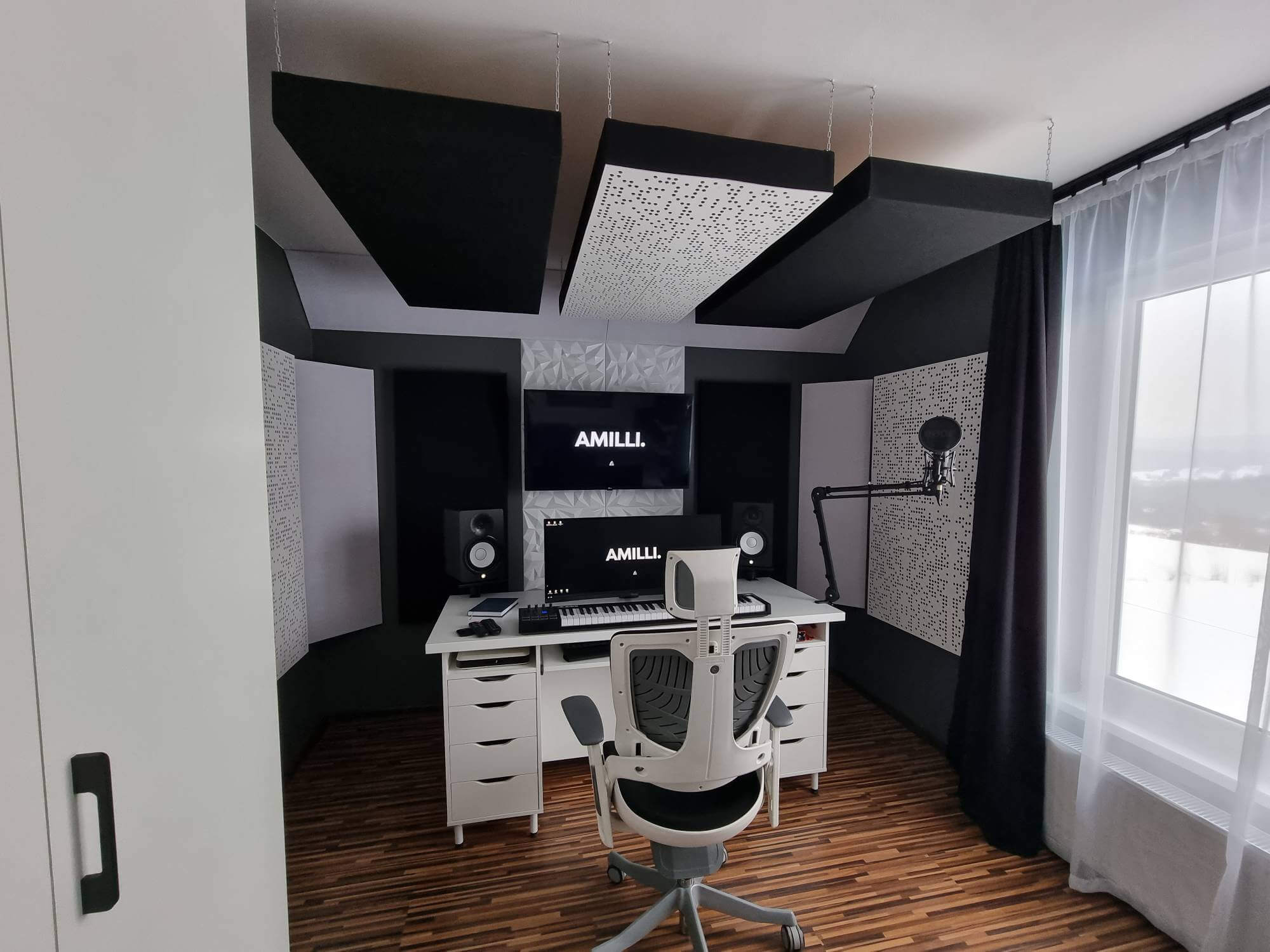
He built the panels too: “These panels also have densely compacted acoustic wool in them — every bit of these panels I’ve done myself as well. My brother helped with CNC’ing the holes, though. Kudos!” He also placed his listening position at a set distance from the front wall rather than wherever the desk happened to fit, which matters as much as the panels for anyone mixing audio.
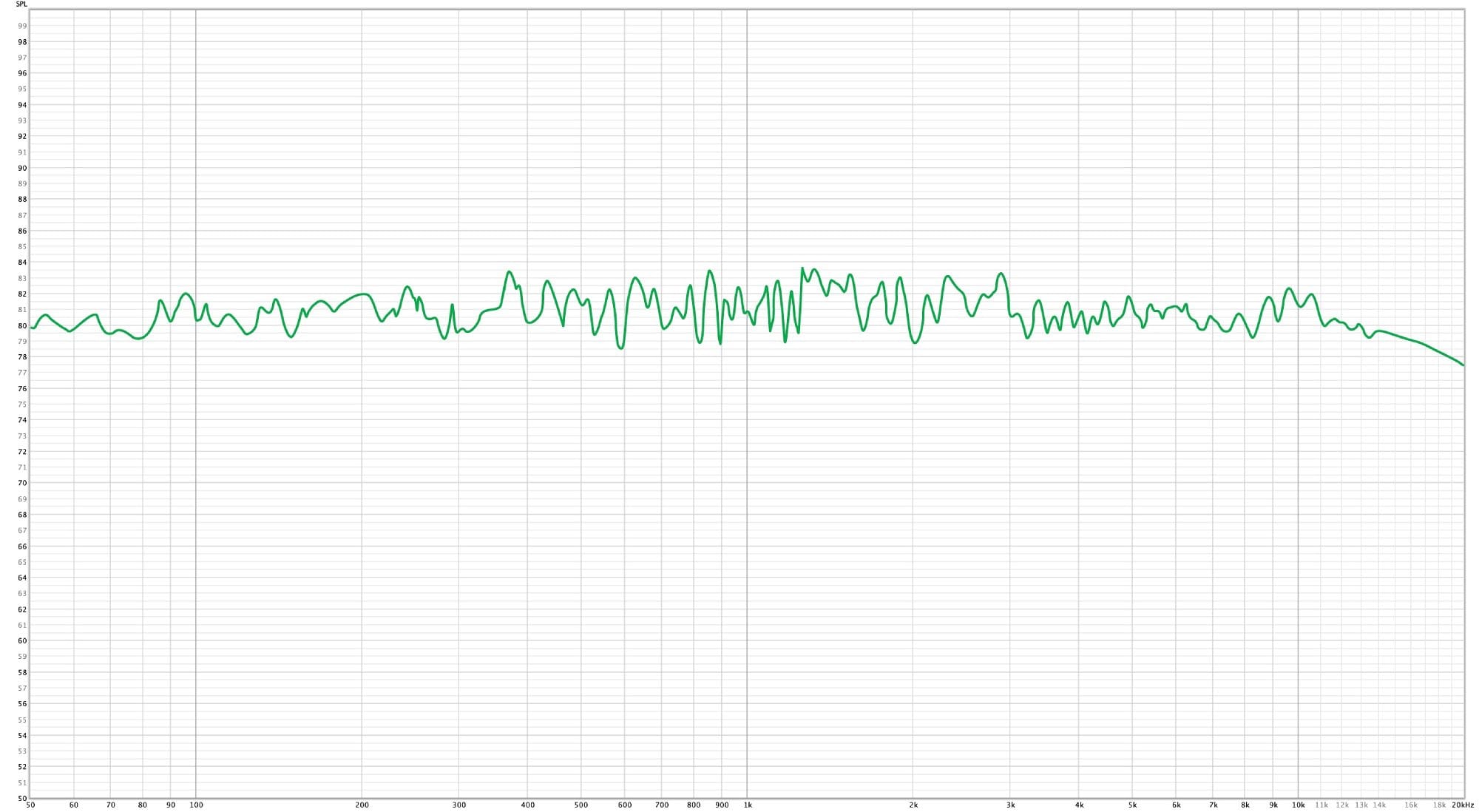
At the far end of the scale, James Zhan, a videographer and former audio engineer in Toronto, says his home studio “was treated with acoustic panels to achieve near sonic perfection (see the graph below) for audio mixing and mastering work”. A measured frequency response like his is the only way to know for certain what treatment has done; for an ordinary home office, recording yourself before and after is a free substitute.
Focus, privacy and looks: what is realistic
Focus. The GSA guide identifies conversation as the main source of disruptive office noise and lists what distractions do, starting with shifts in attention that reduce focus. Panels help by making nearby speech decay faster, but the guide pairs absorption with distance, barriers and background sound masking because absorption alone does not make a shared room quiet.
Privacy. Expect little. Panels do not stop your call being heard in the next room, for the reasons above. Even in open offices the GSA guide treats high partitions as a myth when it comes to privacy: it says they provide small amounts of additional acoustical shielding and may encourage people to talk louder. A desk screen still absorbs some of the sound closest to you, which is worth having in a shared room, but it is not a private booth.
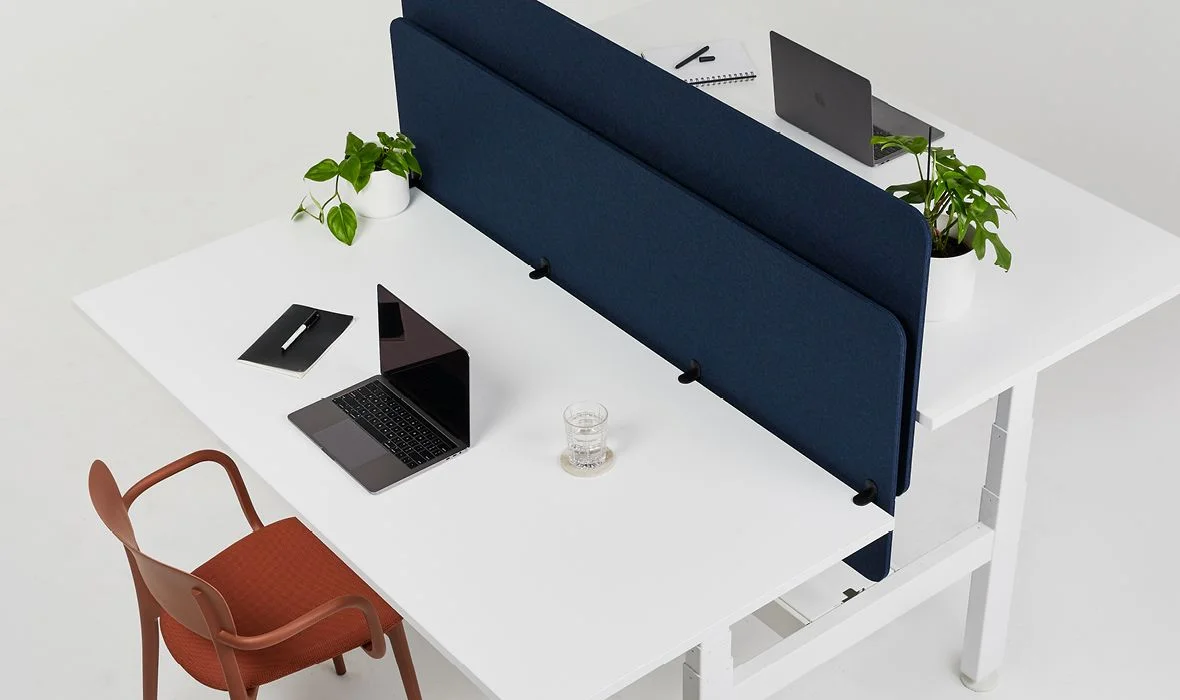
Looks. Fabric, felt and timber panels are also decoration, and for many owners that is half the reason. It is often said that an attractive workplace positively affects productivity, but the 2019 University of Tennessee at Chattanooga thesis behind that link is more careful: in a survey of 175 full-time employees, more aesthetically pleasing workplaces went with lower negative work attitudes mainly for people with a high need for an aesthetically pleasing workspace and high mindfulness, and no effect on job satisfaction was found. It did not measure output.
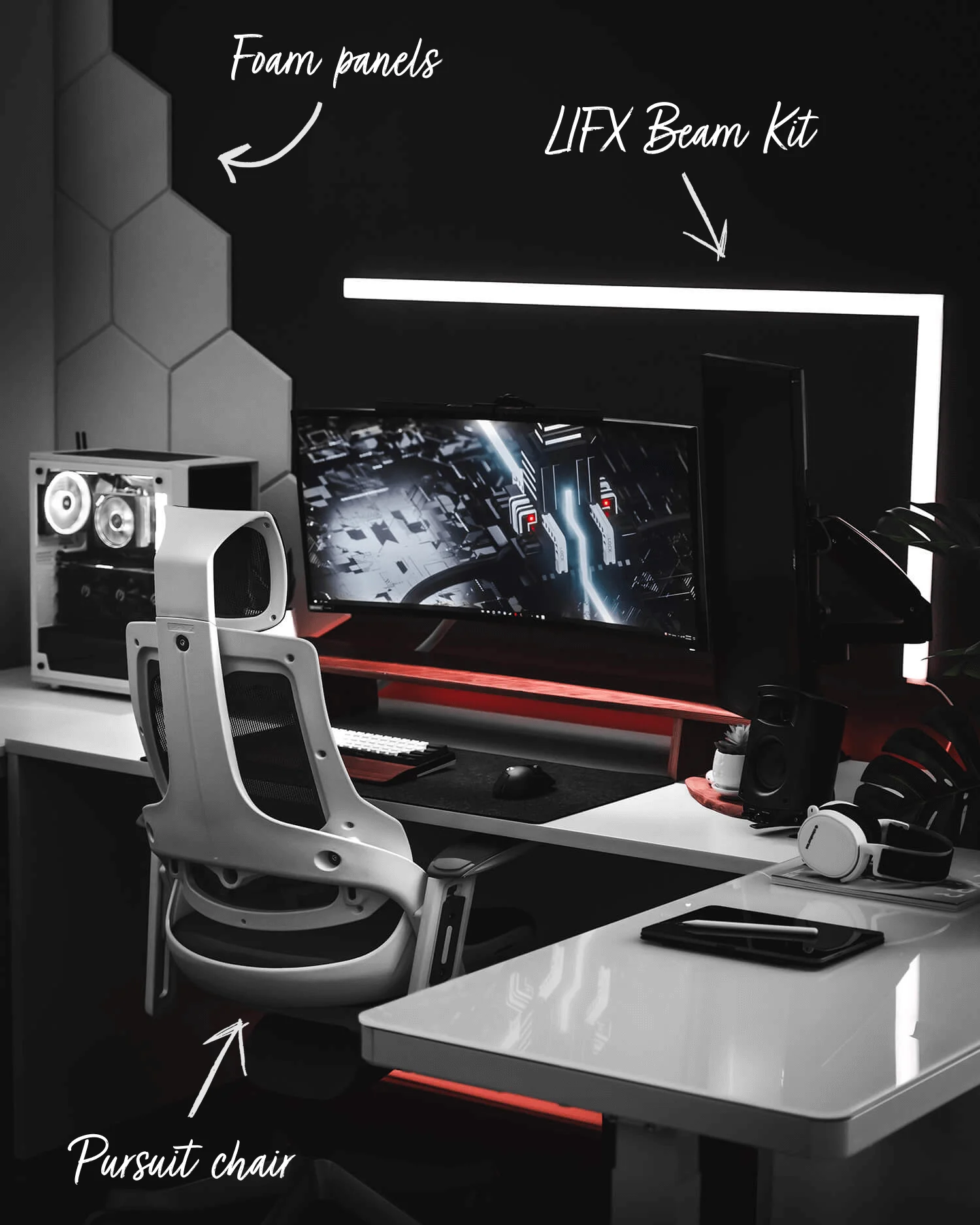
Jay, a power plant operator in California, is candid about which of the two jobs his hexagonal foam tiles do: “They are supposed to help with soundproofing but I haven’t done any audio work to know if they actually work well. However, they do look cool.” Rosdi Annuar in Selangor, Malaysia lists a Reforma Acoustic Panel on the wall in his gear list. Both are fair choices, as long as you know whether you are buying for sound or for style.
The safety question: fire, not noise
Ordinary office noise is not a hearing-safety issue that panels solve. In Great Britain, the Health and Safety Executive sets the lower exposure action value at a daily or weekly exposure of 80 dB(A), and notes that the Noise Regulations do not apply to “low-level noise that is a nuisance but causes no risk of hearing damage”.
The real safety question is what the panels are made of and whether they burn. In the 2003 Station nightclub fire in Rhode Island, pyrotechnics ignited polyurethane foam lining the walls and ceiling of the stage platform. One hundred people lost their lives. The NIST investigation found that a non-fire retarded foam sample ignited within 10 seconds when exposed to a pyrotechnic device, while a fire retarded sample did not ignite under similar conditions.
A home office has no pyrotechnics, but it does have chargers, lamps and power strips, and wall panels are a large area of material next to them. Before you cover a wall, look for the product’s surface-burning test result. Owens Corning, for example, publishes a Flame Spread Index of 5 and Smoke Developed Index of 5 for its unfaced board under ASTM E84 on the data sheet linked above. If a cheap foam panel’s listing gives no fire rating at all, treat that as a reason to choose something else.
Buying versus building
Prices vary too much by size, material, finish and country to quote usefully, and they change often. What does change the cost is whether you build. Kamil made every panel in his studio himself, and his interview lists the whole room renovation at “~$2K (renovation; Kamil did everything himself)”, on top of the equipment. Jake, a business analyst in Warsaw, also built his own; his next job, he says, “is to finally hang the acoustic panels I made six months ago”.
Whichever route you take, judge a panel by three things: its absorption figures across the frequency range (not just NRC), its thickness if you need low-frequency control, and its fire test result. And if the noise you want rid of comes from outside the room, spend the money on doors, seals and walls instead.
