

In a small room, whether a chair fits comes down to three numbers that most product listings bury: the diameter of the base, the overall width including the arms, and whether the arms let the seat slide under your desk. This guide gives those numbers for six chairs, taken from each manufacturer’s own published specifications (checked on 17 November 2026), and shows what owners interviewed on Maker Stations chose for their own small rooms.
It is not a test report. We have not sat in these chairs side by side. The figures come from the makers and the experience comes from named owners. Where a maker does not publish a figure, the table says so rather than filling the gap.
What makes a chair fit a small space
The base sets the footprint
The seat is rarely the widest part of a task chair. The five-star base is. OSHA’s guidance on computer workstation chairs recommends a five-leg base with casters, so for a normal office chair the base diameter is the floor area you have to give up. Among the chairs below whose makers publish it, it ranges from 26.0 in on the Herman Miller Sayl to 27.6 in on the Branch Ergonomic Chair. The backless Varier Move stands on a 40 cm base. Measure the clear floor between your desk legs, drawer unit and the wall behind you against that figure.
Listed depth figures are not comparable
Herman Miller’s own store gives the Sayl’s depth as 19¾ in. Its Sayl technical specifications give an overall depth of 26 in, and they explain the difference: overall depth is measured from the forward caster position or extended seat to the back. Other brands do not always say which method they use, so treat any single depth figure with caution and plan around the base diameter, which cannot be measured more than one way.
Arms add width and can stop the chair tucking in
The same Sayl specification sheet shows how much arms cost you. The chair is 23.5 in wide with no arms, 24.75 in with fixed or height-adjustable arms and 26.75 in with fully adjustable arms. OSHA notes that armrests that are too large or badly placed may interfere with positioning the chair, and if the chair cannot get close enough to the keyboard you end up leaning forward. In a small room there is a second problem. If the armrests sit higher than the underside of your desk, the seat cannot slide under it when you finish, and the chair stays in the middle of the room.
There are three ways round this: buy the armless version, choose arms that come off (Branch’s are removable) or flip up (the Flash drafting chair’s do), or take the arms off afterwards, as one owner below had to.
Seat height and seat depth: what the guidance says
A compact chair is no use if it does not fit your body. OSHA’s chair guidance says the seat height is right “when the entire sole of the foot can rest on the floor with the back of the knee slightly higher than the seat of the chair”. It also recommends a seat pan that adjusts forwards and backwards, so shorter users can sit against the backrest without the seat edge reaching their knees and taller users still have their thighs supported.
The UK’s Health and Safety Executive gives a simple check for seat depth in its guidance on posture at a computer: a gap of 2-3 cm between the front of the seat and the back of your knee. If you can only fit a finger or two there, the seat is too deep for you. The UK’s Display Screen Equipment Regulations 1992 set the legal minimum for a work chair: the seat must be adjustable in height, the seat back adjustable in both height and tilt, and a footrest made available to anyone who wants one.
A footrest is often the cheapest fix in a small room, where the desk height is usually fixed. Alex Napier Holland, who works in a 5,25 m² room on Portugal’s Algarve coast, says in his Maker Stations interview: “And a hairdresser footrest is a simple and effective ergonomic upgrade.”
Six chairs compared on the makers’ own figures
Figures are given in the units each manufacturer publishes (W = width, D = depth, H = height). A dash means the maker’s page does not state the figure.
| Chair | Overall W × D × H | Base diameter | Seat height | Seat depth | Weight capacity | Source |
|---|---|---|---|---|---|---|
| SIHOO M57 | 28 × 28 × 42–49 in | – | – | 18.11 in | 330 lbs | SIHOO |
| Herman Miller Sayl | W 23.5–26.75 in (by arm type); D 26 in; H 34¾–39¼ in | 26.0 in | 16–20.5 in | 16 in fixed, or 16–18 in adjustable | 350 lbs | Herman Miller store; spec sheet |
| Steelcase Series 1 | 597–686 mm × 534–603 mm × 927–1048 mm | 660 mm | 420–547 mm | 400–458 mm (functional) | 400 lbs | Steelcase; Steelcase EU (base) |
| Branch Ergonomic Chair | 25 × 24 × 38–42 in | 27.6 in | 17–21 in | 18–22 in | 275 lbs | Branch |
| Flash Furniture BL-ZP-8805D drafting chair | 27 × 27 × 42–49.5 in | – | 21.5–29.0 in | 19.0 in | 250.0 (unit not given) | Flash Furniture |
| Varier Move | Round seat, Ø 43 cm | 40 cm | 56–82 cm | Round seat, Ø 43 cm | Tested for users up to 110 kg | Varier |
SIHOO M57: the full-featured chair a student fitted into a bedroom
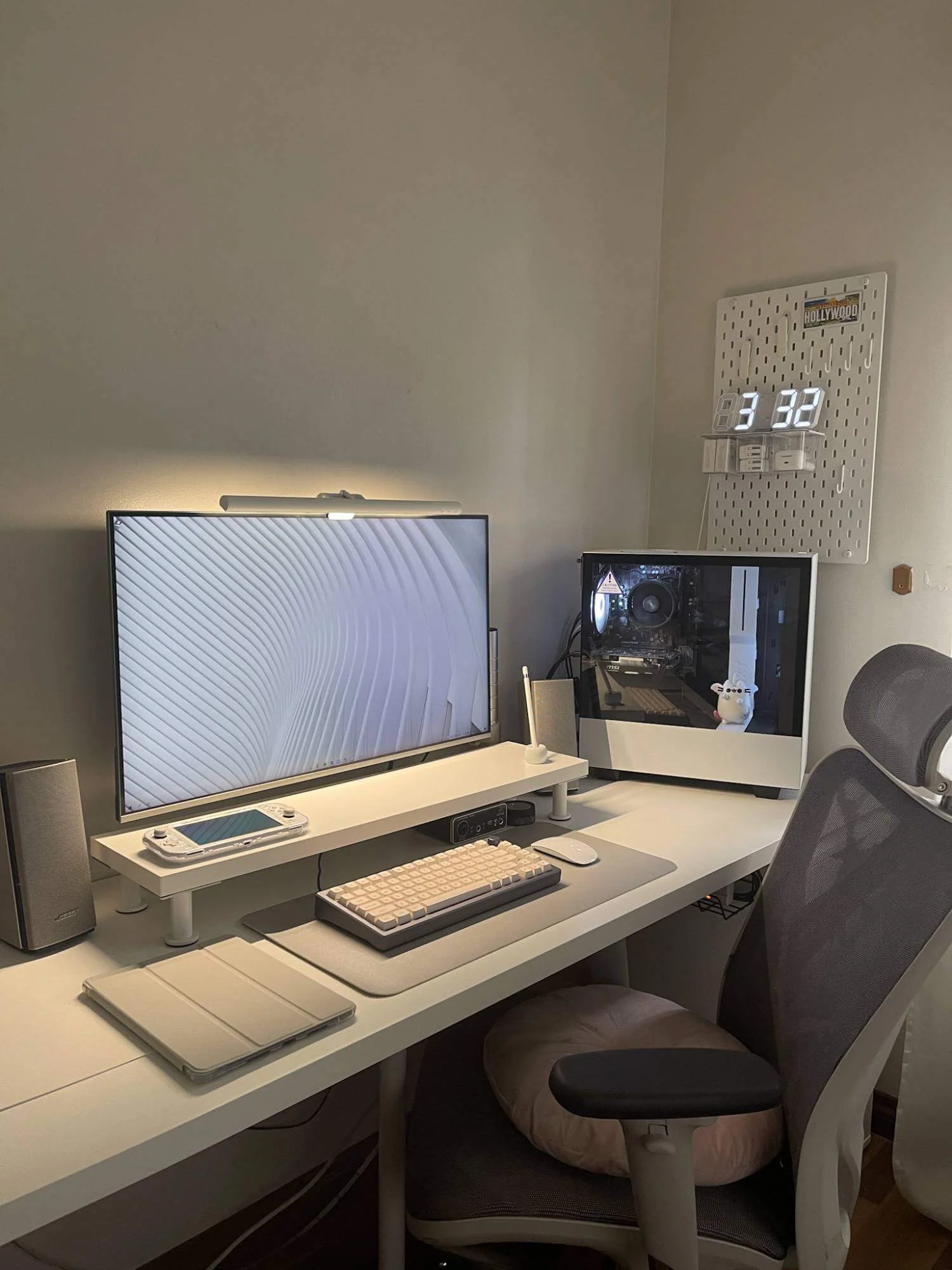
Aliza Ceralde, a visual communication student in Manila, uses a SIHOO M57 in a 10,9 m² bedroom (interview linked in the caption above). Her problem was not the chair’s size but the room: “Dividing such a small space was also a struggle. My bed is so close that it’s hard to focus and it’s always tempting to fall asleep.” She turned the desk to face the opposite wall.
On paper, the M57 is the opposite of a compact chair. SIHOO lists its general dimensions as 28 in wide by 28 in deep, which makes it among the bulkiest here, with a headrest and 3D armrests. What it offers in return is adjustable lumbar support and a headrest in a single mesh chair. An earlier version of this page gave a seat depth for an “M57B” that simply repeated its seat-height range. SIHOO’s M57 product page gives a seat depth of 18.11 in and a maximum load of 330 lbs, and it does not publish a seat-height range, so check that against your desk before buying.
Herman Miller Sayl: pick the arm option to suit the room
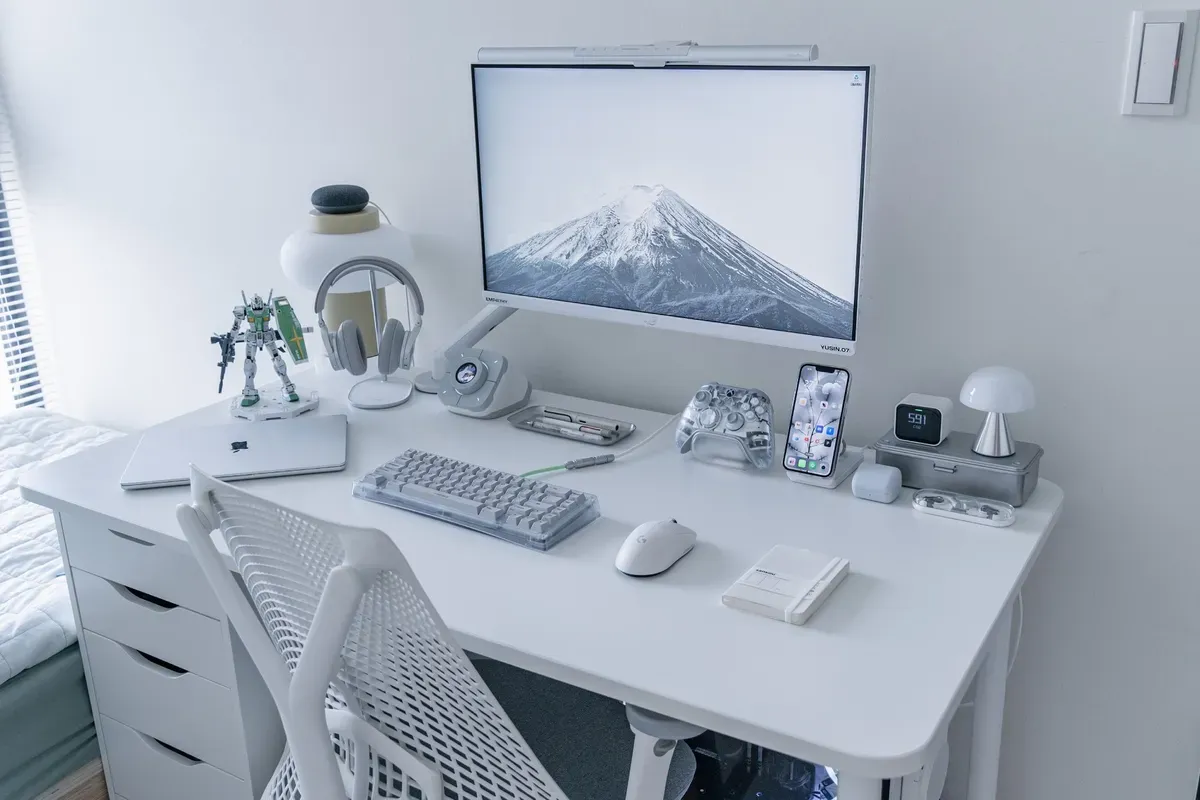
Yu Sin, Hsu, an industrial designer in Taipei, sits on a Sayl in an 8 m² room (interview linked in the caption above). His own summary of the space: “the built-in wardrobe and single bed pretty much take up all the space.”
The Sayl’s 26.0 in base is among the smallest of the five-star chairs here, and Herman Miller publishes width by arm type, so you can see exactly what the arms add. Seat depth is the other choice to get right. According to Herman Miller’s store, the fixed seat is 16 in deep and cannot be adjusted, while the adjustable seat runs from 16 to 18 in. A taller user who needs more thigh support should pay for the adjustable seat.
Steelcase Series 1: a mid-size chair one owner wishes he had bought sooner
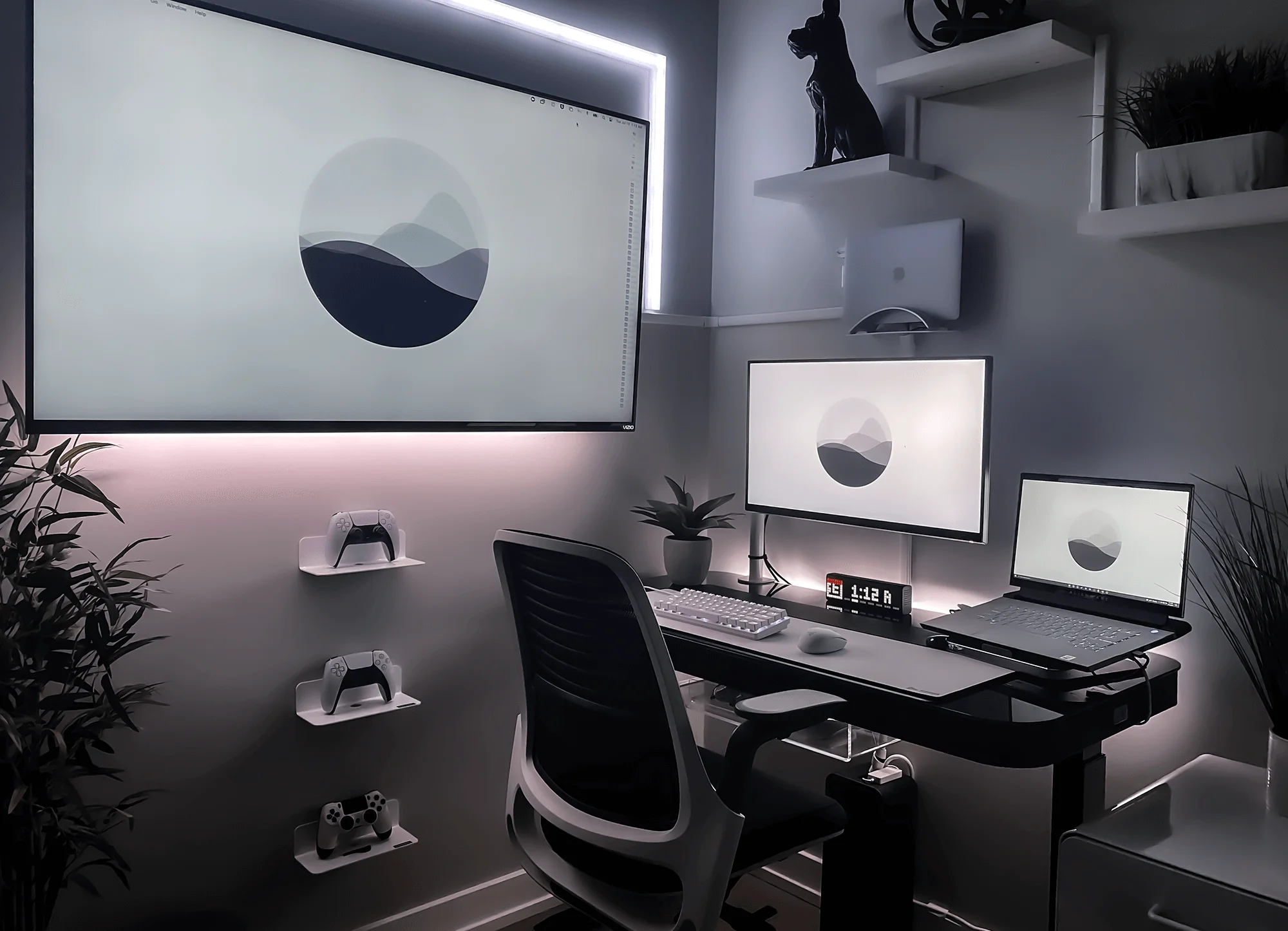
Alex, who works from an 11,6 m² room in Chicago (interview linked in the caption above), mapped out a floor plan before buying anything. He narrowed his chair search to Herman Miller and Steelcase and chose a custom-built Series 1. His advice: “I initially cut corners on buying a cheaper chair and I paid for it when my neck and back started to chronically act up.” And on the switch: “Stepping up to the Steelcase Series 1 chair has been wonderful, and I wish I had done it sooner.”
Steelcase’s Series 1 dimensions put its overall width at 597–686 mm, depending on configuration, and its functional seat depth at 400–458 mm. That range starts shorter than the other adjustable seats here, which suits shorter users who need the HSE knee gap. Steelcase states the chair can handle weight up to 400 lbs, the highest rating in this list. Its base, at 660 mm according to Steelcase’s European page, is similar to the Sayl’s.
Branch Ergonomic Chair: removable arms and a deep seat
Branch lists the chair at 25 in wide overall, but its armrest width adjusts from 25 to 29 in. With the arms pushed out, the chair is wider than its headline figure. The arms are removable, which solves both the width and the desk-clearance problem if you can do without them. The seat depth of 18–22 in is the deepest range here, good for long legs and too deep for some shorter users, so check it against the 2-3 cm gap. The 27.6 in base is also the widest in the table. All figures are from Branch’s product page, which rates the chair to 275 lbs. An earlier version of this page gave the seat-depth range as the chair’s overall depth.
Flash Furniture drafting chair: for counter-height desks, with flip-up arms
If your small space has a tall desk, a counter or a standing desk you rarely lower, an ordinary chair will not go high enough. Flash Furniture’s BL-ZP-8805D mid-back drafting chair has a seat height of 21.5 to 29.0 in, a height-adjustable foot ring to rest your feet on and arms that flip up so the chair can be pushed in. Flash gives overall dimensions of 27 in deep by 27 in wide, a fixed seat depth of 19.0 in and a weight capacity of 250.0, without stating the unit.
Varier Move: the smallest footprint, as a second seat
The Move has no back and no wheels. It sits on a rounded wooden base that tilts as you shift your weight. That makes it the opposite of what OSHA describes for a main work chair, but it also gives it the smallest footprint here. Varier lists a 43 cm seat, a 40 cm base and a seat height of 56–82 cm. That height is meant for perching at height-adjustable desks or tabletops from about 80 cm to 105 cm, and Varier points people with lower surfaces to the Move Compact. It is tested for users up to 110 kg. An earlier version of this page gave different dimensions and a 150 kg limit that Varier’s page does not support.
How owners made a chair fit
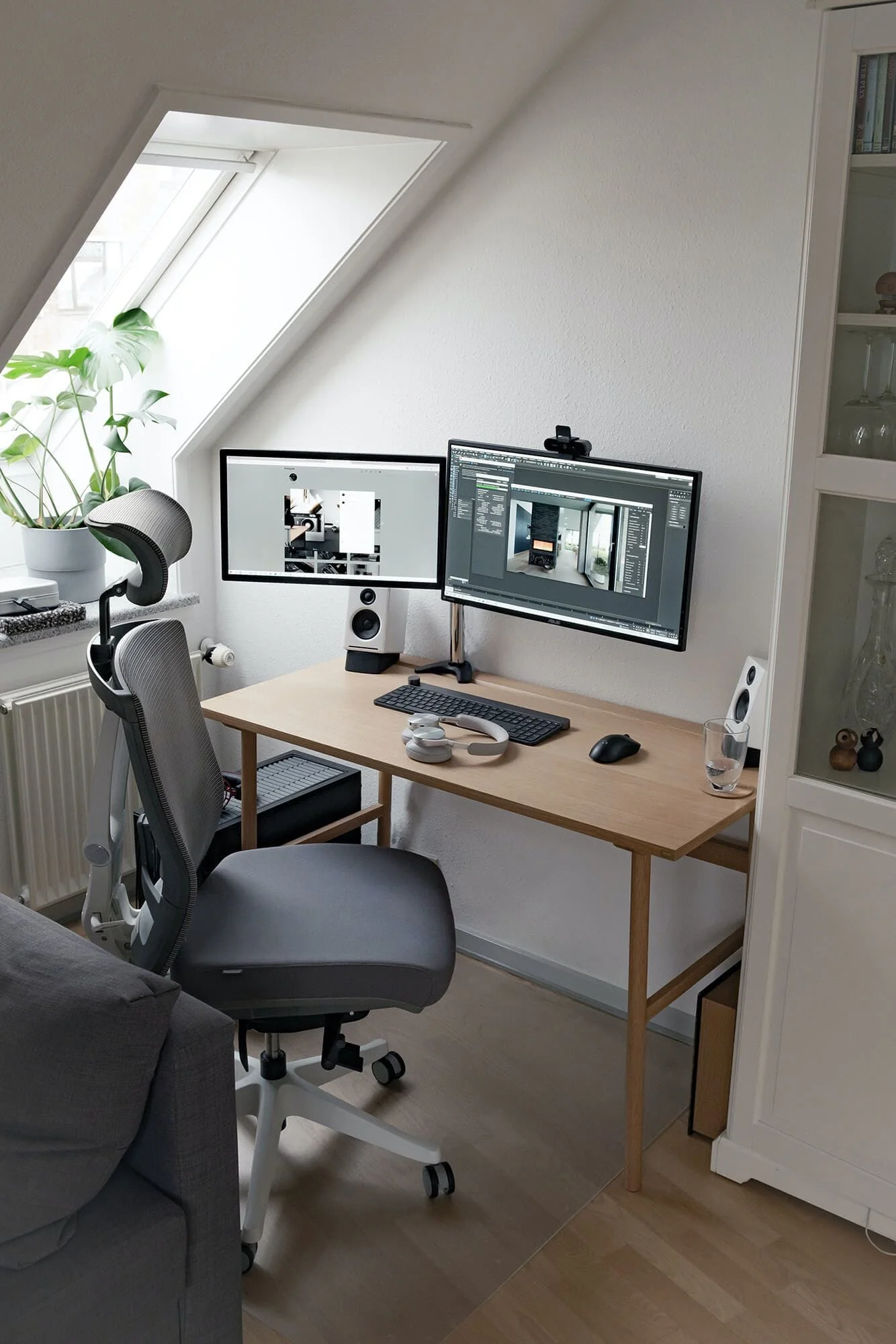
Take the arms off. Lasse Jensen in Odense works at a desk by the window of a shared living room (interview linked in the caption above). Of his Autonomous Ergo Chair 2 he says: “Quite a good chair for the money, although I did have to remove the armrests to make it fit in my tiny space. Not a big problem, I’m not a big armrest guy anyway.” The ErgoChair 2 is no longer in Autonomous’s range. Its current chair dimensions page covers the ErgoChair Core, Pro, Mesh, Ultra 2 and Ultra 2 Plus, so this page gives no figures for it.
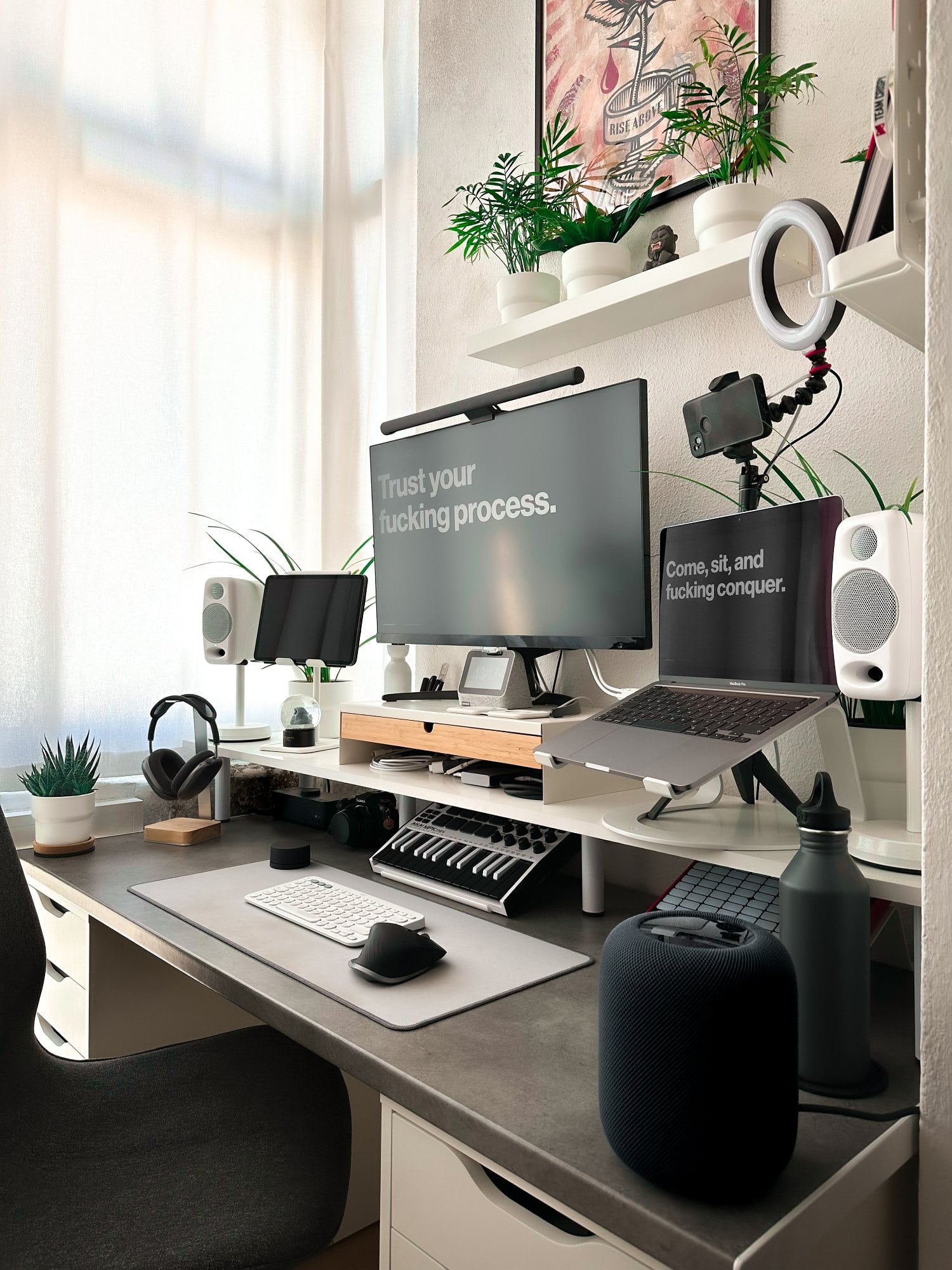
Choose no arms from the start. Alex Napier Holland chose an armless IKEA LÅNGFJÄLL “with no arms (I play guitar)” for a room of 5,25 m², and uses a hairdresser footrest with it. His wider rule for a small room, from his interview: “The most important thing with a smaller build is to plan ahead and choose office furniture that maximises vertical and horizontal space — with respect for the layout and flow of the room.”
Make the desk disappear instead. Chris, in a 12 m² bedroom in Virginia Beach, kept his Secretlab OMEGA gaming chair. Instead of shrinking the chair, he mounted an IKEA Bjursta drop-leaf table on the wall so desk and chair can be moved out of the way. As he told Maker Stations: “One of my concerns when starting this project was that I still wanted to feel like I had a lot of space in the room.”
Four measurements to take before you buy
- Clear floor under and behind the desk, to compare with the chair’s base diameter, not its seat width.
- Width between desk legs or drawer units, to compare with the chair’s width with the arms in the position you will use them.
- Height of the underside of the desk, to compare with the armrest height at the lowest setting. If the arms are higher, plan on armless, removable or flip-up arms.
- Your own seat height and thigh length. Use the knee checks above, then compare them with the seat height and seat depth ranges in the table.
We’re a reader-supported publication. This article might contain affiliate links. It means we may receive a commission if you click a link and buy a product that our maker has recommended. The interview was done independently.
