

A windowless room has two problems, and only one is how it looks: its air does not change unless you change it, and its walls only return the light you put in. So fix the fresh air first, then the surfaces: pale, matt walls and ceiling, storage up the wall, and as little on the floor as you can manage.
The nine steps below follow that order, using what owners of basement and windowless offices on Maker Stations did, plus UK Health and Safety Executive (HSE) and US Environmental Protection Agency (EPA) guidance.
Sort out the air first, especially below ground
A stuffy room feels small however you paint it. HSE lists better concentration and better quality of sleep among the things good ventilation is associated with. Without a window, the only routes for fresh air are the door, any vent or air brick, and a fan that moves air to or from outside.
A carbon dioxide monitor tells you whether that is enough, because the CO2 you breathe out builds up when air is not replaced. HSE’s guidance on using CO2 monitors is written for workplaces, but carries over:
- Use a non-dispersive infrared (NDIR) monitor at head height, away from the door and more than 50cm from where you sit, as your breath inflates the reading.
- Take readings across a working day; HSE warns that “Single or ‘snapshot’ readings can be misleading.”
- HSE gives 1000ppm as equivalent to about 10 litres per second per person, and says “CO2 levels consistently higher than 1500ppm in an occupied room indicate poor ventilation”.
- HSE says monitors are of limited use where few people are present, so in a one-person office treat the number as a broad guide, alongside how stuffy the room feels.
If readings are high, a desk or ceiling fan will not help: HSE says such fans won’t improve fresh air. Nor will an air purifier, which removes contaminants but does not remove CO2 or improve ventilation, according to the same CO2 monitor guidance. Airing the room does: HSE says opening doors fully, even 10 minutes an hour, can help, depending on the size of the room. The lasting fix is a vent or mechanical ventilation that brings in outside air, which is a job for a ventilation engineer.
Many windowless offices are below ground, and a basement room needs three more checks before it can feel cosy.
- Damp. The EPA advises keeping indoor humidity below 60 percent (ideally between 30 and 50 percent), measured with an inexpensive humidity meter.
- Cold. UK workplace guidance says an indoor workplace should normally be at least 16°C. That rule is for employers, but it is a useful floor for a room you sit in all day.
- Radon. This colourless, odourless radioactive gas comes from rocks and soils. The UK Health Security Agency puts the average in UK homes at 20 becquerels per cubic metre and sells home test packs. The EPA’s Citizen’s Guide to Radon says to retest if you begin occupying a lower level such as a basement, and to fix a home whose long-term result is 4 pCi/L or more.
Paint it in a light, airy colour
With lamps as the only light, walls and ceiling decide how far it goes. HSE’s guide Lighting at work puts it plainly: “dark surfaces reflect very little light”, while light reflected off the walls is spread more evenly than direct lighting and “can soften shadows”. For dim or uneven light, one of HSE’s listed fixes is to change the decor to light colours.
Paint makers measure this as light reflectance value (LRV), which Tikkurila describes as a scale of 0 (black) to 100 (white). Ask for the LRV and put the highest values on the ceiling and the wall you face. Pale does not have to mean clinical white: soft greys, powdery blues and blush pinks with a high LRV work too. Prefer matt finishes: where bright reflected images sit next to the task, the same HSE guide suggests changing a shiny workstation surface to a matt one.
Graham Neff’s basement office in Minnesota has a single egress window on the far wall. His wife, a former interior designer, chose a white and black scheme, and he was hesitant about so much white at first. “It makes the room feel much more spacious even at night, and the black accents pop”, he says, and in his words “the abundance of white helps compensate” for the missing daylight (Graham’s interview).
Make the most of your vertical space
Every box on the floor is one more thing the eye stops at. Move storage up the wall: tall shelving, wall shelves and pegboards keep the floor clear, and a clear floor makes a small room read as bigger.

Matt Morris, in an 11 m² basement office in Kansas, did this: “A pegboard wall holds my camera gear, headphones, and accessories — all within reach but off the surface” (Matt’s interview). Lloyd Carig, whose 7 m² office in Vancouver is a den where “There’s no window and no natural light coming in”, keeps camera charging cables and other small bits on an IKEA SKÅDIS pegboard he spray-painted matte black (Lloyd’s interview).
Mount what you can, too. Eric Kennedy’s basement office in Pennsylvania has a built-in bookshelf and a floating desk built by his wife’s grandfather; “the way the desk is mounted makes it feel as though it is one with the wall” (Eric’s interview).
Light the room sensibly
A single ceiling fitting leaves the corners dark and the room looking smaller; light on walls, shelves and ceiling lets pale surfaces do their job. Our guide on how to brighten a windowless home office covers lamps and placement in detail.
Plan lights so they take no floor space. Lloyd lights his den with four hanging lights, a lamp and a light strip, and plans a ceiling mount for his softbox so that it “won’t be taking any floor space too”.

Furnish a windowless home office wisely
Use fewer, larger pieces, and choose furniture that shows floor underneath: a desk on legs, shelves fixed to the wall. Raising a cabinet on legs or levellers lets light run under it, so even a bulky item looks lighter.
Size the desk to the room. Eric sold a PC whose monitor was too big for the space. Joakim Nilsen’s 7,5 m² basement music studio in northern Norway holds only his workstation, a two-seat sofa and a few small instruments; it is too small for ideal acoustics, “but since I thrive in small spaces, it’s the perfect size for the vibe I’m looking for” (Joakim’s interview).
If the room has another use, put the desk at the far end from it. Conor Butkovic, whose bedroom office is in his parents’ basement in Ontario, chose the spot “farthest from my bed and couch” because “That makes it easier to separate work and relaxation” (Conor’s interview).
Add some greenery, with a light for it
Plants soften a hard, bare room, but no plant lives without light, and ordinary room lamps are rarely enough. Our guide to plants for a windowless home office covers which plants cope with low light, what a grow light needs to provide, and the owners who chose artificial plants instead.

Make your flooring seamless
A floor that changes at the doorway draws a line around the room. Where you can, continue the flooring from the room or hall next door so the eye carries on through.
On a cold concrete basement floor, a rug is the exception worth making: one large rug under the desk and chair, not several small ones that break the floor into patches. Joakim laid carpet over his unheated concrete floor, and says “It was all about comfort and aesthetics”.
Expand space with an illusion of windows
A large mirror adds apparent depth and sends lamp light back into the room. A mirror made to look like a window frame, like the one below, also gives a blank wall the outline of a window.

Sit in your chair and check what the mirror shows: if it puts a bare bulb or bright lamp in your line of sight, move it. HSE’s Lighting at work lists bright reflected images next to the task as a lighting hazard and suggests using a mirror to find the source.
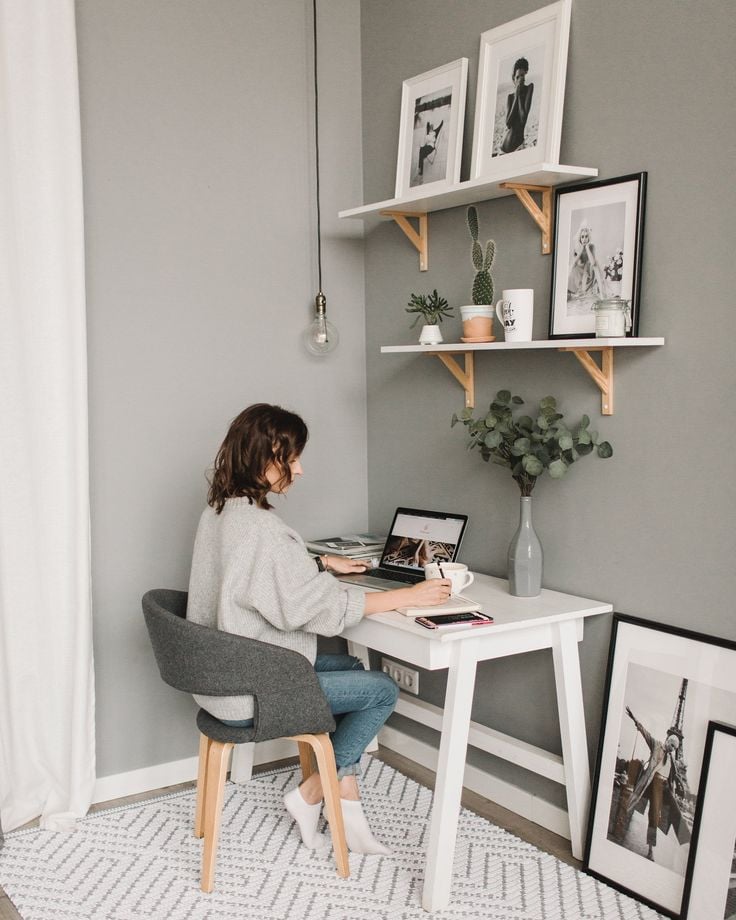
Art does a similar job without reflections: one large landscape print or an old window frame reads as a view, where many small frames make a small room look busier.
Make it yours, including how it smells
A room with no view needs something to look at. Graham’s favourite items are black and white prints from a trip to Japan, which gave him the idea for his colour scheme; Lloyd has a framed blueprint of a vintage camera on his bookshelf. A few things that mean something to you, where your eyes rest when you look up, do more than a lot of decoration.

Scents are personal too, and Lloyd says “A couple of scented candles bring a pleasant aroma to the small room that I’m in.” Pick a scent because you like it, not because it promises to sharpen your mind: the US National Center for Complementary and Integrative Health says little rigorous research has been done on aromatherapy for sleep, and in one study of people under stress, lemon lifted mood but neither lemon nor lavender affected stress indicators.

If you use a diffuser, choose an oil you enjoy. One supplier describes the aroma of its Cilantro essential oil as “Herbaceous, green, grass-like”, for example. In a room without a window, though, go easy: the EPA lists products like air fresheners among indoor sources that can release pollutants, and says inadequate ventilation can raise indoor pollutant levels by not bringing in enough outdoor air to dilute them. Sort out the fresh air first, then add the scent.
We’re a reader-supported publication. This article might contain affiliate links. It means we may receive a commission if you click a link and buy a product that our maker has recommended. The article was written independently.
