

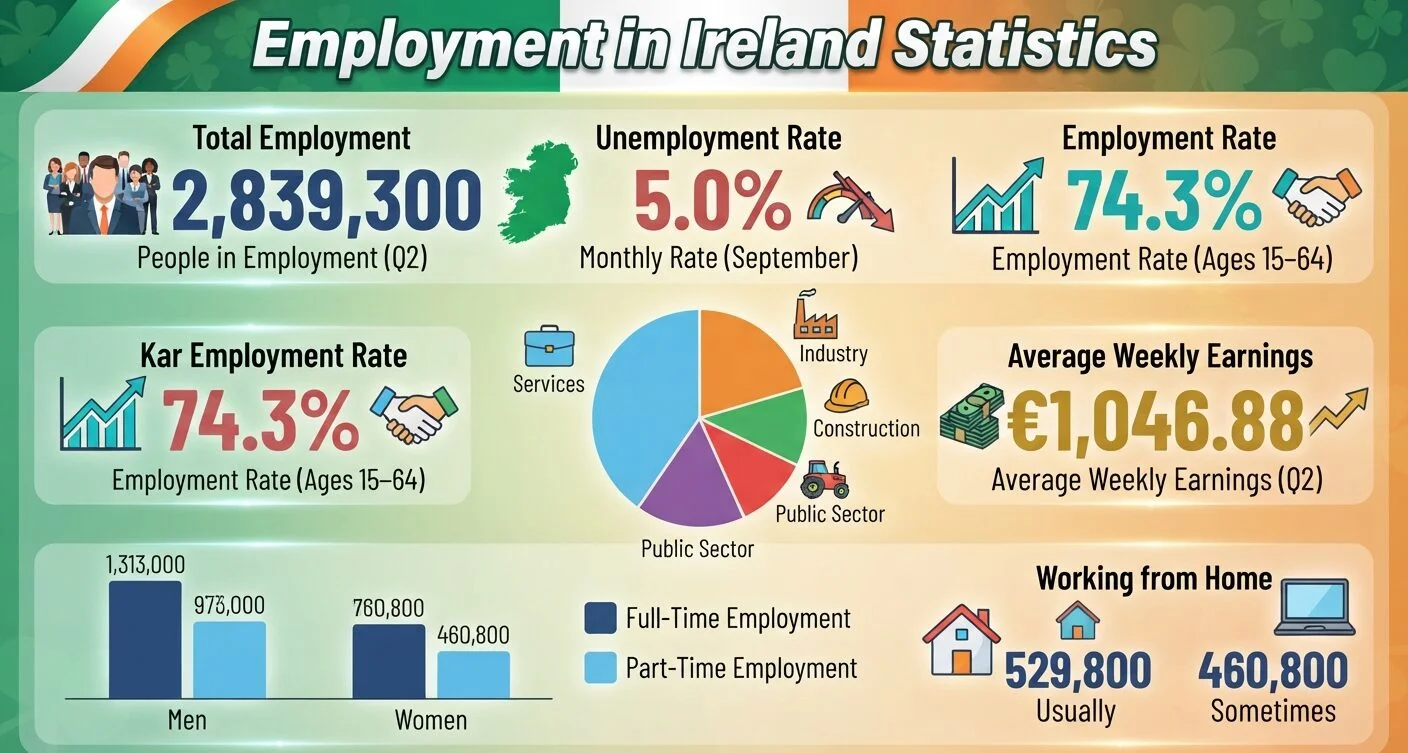
Ireland had 2,839,300 people in work in Q2 2026, while the CSO’s latest monthly estimate put unemployment at 149,500 in September 2026. This guide brings together employment in Ireland statistics from the Labour Force Survey, monthly unemployment releases, Q2 2026 earnings data and Eurostat’s August 2026 comparison, covering jobs, sectors, pay, gender, age and working from home.
Employment In Ireland Statistics
How Many People Are Employed in Ireland?
Ireland had 2,839,300 people aged 15 to 89 in employment in Q2 2026. That was 21,200 (0.8%) more than the 2,818,100 recorded in Q2 2025.
The labour force grew faster, adding 31,300 people (1.1%) to reach 2,990,200. Unemployment rose by 10,100 over the same 12 months.
Seasonally adjusted employment rose by 19,500 (0.7%) in Q2 2026 to 2,831,100. That matched the 19,500 fall recorded in Q1 2026.
Total hours worked held at 89.0 million a week. The figure was unchanged on Q2 2025 and 1.7 million hours (1.9%) above Q2 2024.
Source: CSO, Labour Force Survey Quarter 2 2026 (April–June 2026), published 20 August 2026
Employees vs Self-Employed in Ireland
Employees numbered 2,456,900 in Q2 2026, up 18,300 (0.7%) on a year earlier. Self-employed workers reached 359,200, up 2,800 (0.8%).
Source: CSO, Labour Force Survey Quarter 2 2026
Ireland’s Unemployment Rate Held at 5.0% in September 2026
The CSO’s seasonally adjusted monthly unemployment rate was 5.0% in September 2026. It was unchanged from August and up from 4.9% in September 2025.
That rate equals 149,500 people out of work, 5,800 more than a year earlier. The male rate was 4.9% and the female rate 5.2%.
Youth unemployment (ages 15 to 24) stood at 12.5%, while the rate for people aged 25 to 74 was 4.0%. The CSO lists July to September 2026 as forecasts that may be revised.
Source: CSO, Monthly Unemployment September 2026 (seasonally adjusted), published 30 September 2026
Unemployment Rates by Group in the Q2 2026 LFS
The quarterly Labour Force Survey is Ireland’s official measure. It recorded 151,000 unemployed people and a 5.1% rate in Q2 2026.
| Group (ILO unemployment rate) | Q2 2025 | Q2 2026 |
|---|---|---|
| All persons, 15–74 | 4.8% | 5.1% |
| Men | 5.0% | 5.0% |
| Women | 4.5% | 5.2% |
| Aged 15–24 | 13.2% | 13.2% |
| Aged 25–74 | 3.6% | 3.9% |
| Long-term unemployment rate | 1.1% | 1.3% |
Source: CSO, Labour Force Survey Quarter 2 2026 (Q2 2025 and Q2 2026)
Unemployed women rose by 10,300 (16.4%) to 73,000 over the year. Unemployed men fell by 100 to 78,000.
People aged 25 to 74 added 10,800 (11.8%) to the unemployed total, reaching 102,100. Unemployed 15–24 year-olds fell by 700 to 48,800.
Long-term unemployment rose 7,200 (22.6%) to 38,900. Its share of all unemployed people climbed to 26.6% from 23.2%.
Source: CSO, Labour Force Survey Quarter 2 2026
Employment in Ireland by Sector: Weekly Hours, Q2 2024–Q2 2026
| Economic sector (NACE) | Q2 2024 | Q2 2025 | Q2 2026 |
|---|---|---|---|
| Agriculture, Forestry & Fishing | 4.4m | 4.9m | 4.6m |
| Industry | 11.8m | 12.1m | 12.2m |
| Construction | 5.7m | 6.7m | 6.8m |
| Wholesale & Retail Trade | 8.6m | 8.6m | 8.4m |
| Transportation & Storage | 4.1m | 4.1m | 4.5m |
| Accommodation & Food Service Activities | 5.1m | 4.8m | 4.9m |
| Information & Communication | 6.5m | 6.2m | 6.0m |
| Financial, Insurance & Real Estate Activities | 4.6m | 4.6m | 4.9m |
| Professional, Scientific & Technical Activities | 7.0m | 7.0m | 6.2m |
| Administrative & Support Service Activities | 3.5m | 3.6m | 3.5m |
| Public Administration & Defence | 4.9m | 4.9m | 5.0m |
| Education | 5.8m | 5.7m | 6.3m |
| Human Health & Social Work Activities | 10.8m | 11.5m | 11.4m |
| Other NACE activities | 4.0m | 3.9m | 4.0m |
| All sectors | 87.3m | 89.0m | 89.0m |
Source: CSO, Labour Force Survey Quarter 2 2026, Table 2.2 (total actual hours worked per week, millions)
Education added the most jobs in the year to Q2 2026, up 14,200 (5.9%). It also gained 600,000 weekly hours, the largest sectoral rise in hours.
Transport and storage gained 9,800 jobs (7.9%). Air transport accounted for 6,900 of them.
Professional, scientific and technical activities lost 17,100 jobs (8.2%) and 800,000 weekly hours. Architectural and engineering activities and technical testing made up 11,800 of those job losses.
The CSO has published LFS sector estimates under the NACE Rev. 2.1 classification since Q1 2026.
Source: CSO, Labour Force Survey Quarter 2 2026
What Is the Employment Rate in Ireland?
The employment rate for people aged 15 to 64 was 74.3% in Q2 2026. It was 74.7% a year earlier and 74.4% in Q2 2024.
Men had a rate of 78.0% and women 70.7%. Labour market participation (15+) slipped to 66.0% from 66.4%.
By age, 45 to 54 year-olds had the highest rate at 85.8%, up from 85.1%. The 15–19 group had the lowest at 25.6%, and the youth (15–24) rate fell to 45.2% from 46.7%.
Source: CSO, Labour Force Survey Quarter 2 2026
Part-Time Work and Underemployment
Part-time workers numbered 589,600 in Q2 2026, or 20.8% of everyone in employment. Of those, 153,800 (26.1%) were underemployed, meaning they wanted more hours for more pay.
Women held 398,900 part-time jobs and men 190,700. Underemployed part-timers split into 96,700 women and 57,100 men.
Source: CSO, Labour Force Survey Quarter 2 2026, Table 2.1
Average Weekly Earnings in Ireland Reached €1,046.88 in Q2 2026
Average weekly earnings were €1,046.88 in Q2 2026, up 3.9% from €1,007.58, based on preliminary CSO estimates. The CSO noted that the Consumer Price Index rose 3.6% over the same period.
Average hourly earnings rose 3.8% to €31.96. Weekly paid hours edged up to 32.8 from 32.7.
Over the three years to Q2 2026, weekly earnings rose 14.8%. Seasonally adjusted weekly pay reached €1,048.49, up 1.7% on Q1 2026.
Source: CSO, Earnings and Labour Costs Q1 2026 (Final) Q2 2026 (Preliminary Estimates), published 25 August 2026
| Sector | Q2 2025 | Q2 2026 | Annual change |
|---|---|---|---|
| Information and Communication | €1,674.21 | €1,730.61 | +3.4% |
| Financial, Insurance and Real Estate Activities | €1,451.68 | €1,499.23 | +3.3% |
| Professional, Scientific and Technical Activities | €1,228.25 | €1,294.65 | +5.4% |
| Public Administration and Defence; Compulsory Social Security | €1,210.28 | €1,256.79 | +3.8% |
| Industry | €1,126.36 | €1,171.84 | +4.0% |
| Construction | €1,044.48 | €1,089.21 | +4.3% |
| Education | €1,048.53 | €1,077.36 | +2.7% |
| Transportation and Storage | €985.81 | €1,017.32 | +3.2% |
| Human Health and Social Work Activities | €949.20 | €980.94 | +3.3% |
| Administrative and Support Service Activities | €794.50 | €838.79 | +5.6% |
| Wholesale and Retail Trade | €751.75 | €775.16 | +3.1% |
| Arts, Sports, Recreation and Other Service Activities | €712.98 | €679.73 | −4.7% |
| Accommodation and Food Service Activities | €470.59 | €506.78 | +7.7% |
| All Sectors | €1,007.58 | €1,046.88 | +3.9% |
Source: CSO, Earnings and Labour Costs, Table 1 (average weekly earnings, Q2 2026 preliminary)
Accommodation and food services posted the largest annual rise at 7.7%, yet stayed the lowest-paid sector at €506.78 a week. Arts, sports, recreation and other services was the only sector where weekly pay fell.
Public sector employees averaged €1,261.16 a week in Q2 2026, against €978.71 in the private sector. A CSO analysis that adjusts for occupation mix and other factors estimated the 2022 public sector pay gap at between −6.6% and +0.9%.
Source: CSO, Earnings and Labour Costs Q2 2026 (Preliminary Estimates), Editor’s Note
The national minimum wage rose from €13.50 to €14.15 an hour on 1 January 2026 for workers aged 20 and over.
Source: National Minimum Wage Order 2025 (S.I. No. 472/2025); Department of Enterprise, Tourism and Employment
Job Vacancies at the End of Q2 2026
Employers reported 30,000 job vacancies at the end of Q2 2026, down 1,500 from 31,500 a year earlier. The job vacancy rate was 1.3%, unchanged on Q2 2025.
Public administration and defence had the highest vacancy rate at 3.9%. Professional, scientific and technical activities followed at 2.6%.
Source: CSO, Earnings and Labour Costs Q2 2026 (job vacancies on the last working day of the quarter)
How Does Ireland Compare With the EU on Unemployment?
Ireland’s harmonised unemployment rate was 5.0% in August 2026, based on Eurostat data. The EU rate was 6.1% and the euro area rate 6.4%.
All three rates were 0.1 points higher than in August 2025, when Ireland stood at 4.9%, the EU at 6.0% and the euro area at 6.3%.
Eurostat recorded 4.0% for Germany’s labour market, using the trend component instead of seasonally adjusted data.
Rates were higher in France, at 8.2%, and in Spain, at 10.0%.
| August 2026 (seasonally adjusted) | Ireland | EU | Euro area |
|---|---|---|---|
| Unemployment rate | 5.0% | 6.1% | 6.4% |
| Youth (under 25) | 12.3% | 15.4% | 15.0% |
| Men | 4.8% | 5.9% | 6.2% |
| Women | 5.1% | 6.4% | 6.7% |
Source: Eurostat, Euro indicators release of 1 October 2026 (August 2026 data)
Ireland’s youth rate was 12.3% in August 2026, against 15.4% for the EU and 15.0% for the euro area. Youth unemployment in the Netherlands was 8.8%, on Eurostat’s trend measure.
Source: Eurostat, Euro indicators, August 2026
Working From Home in Ireland: 990,600 in Q2 2026
The number of people who worked from home at least some of the time fell by 22,500 (2.2%) to 990,600 in Q2 2026.
| Extent of working from home | People in employment, Q2 2026 |
|---|---|
| Usually (more than half the time) | 529,800 |
| Sometimes (at least one hour in the reference period) | 460,800 |
| Never | 1,839,400 |
Source: CSO, Labour Force Survey Quarter 2 2026
Usual home-workers were down from a peak of 846,700 in Q1 2021. For the 529,800 who still usually work from home, these real home office desk setups show how others arrange the space.
People who sometimes worked from home rose to 460,800 from 457,600 in Q2 2025. Anyone splitting one laptop between both roles may find tips on keeping work and leisure separate on the same computer.
Those who never worked from home rose by 43,800 (2.4%), making up 64.8% of everyone in employment.
Source: CSO, Labour Force Survey Quarter 2 2026
FAQs
What is the current unemployment rate in Ireland?
Ireland’s seasonally adjusted unemployment rate was 5.0% in September 2026, with 149,500 people out of work, per CSO monthly estimates. The official Labour Force Survey rate for Q2 2026 was 5.1%.
How many people are employed in Ireland?
The CSO Labour Force Survey counted 2,839,300 people aged 15 to 89 in employment in Q2 2026. That was up 21,200, or 0.8%, on Q2 2025.
What is the average salary in Ireland?
Average weekly earnings were €1,046.88 in Q2 2026, up 3.9% year on year, based on preliminary CSO estimates. Hourly earnings averaged €31.96. Information and communication paid the most, at €1,730.61 a week.
What is the minimum wage in Ireland in 2026?
It is €14.15 an hour for workers aged 20 and over, effective 1 January 2026 under the National Minimum Wage Order 2025. Lower percentage rates apply to workers under 20.
Is it hard to find a job in Ireland, as many Reddit threads ask?
Official data gives context rather than a verdict. Ireland had 30,000 job vacancies and a 1.3% vacancy rate at the end of Q2 2026, while unemployment stood at 5.0% in September 2026, per the CSO.
