

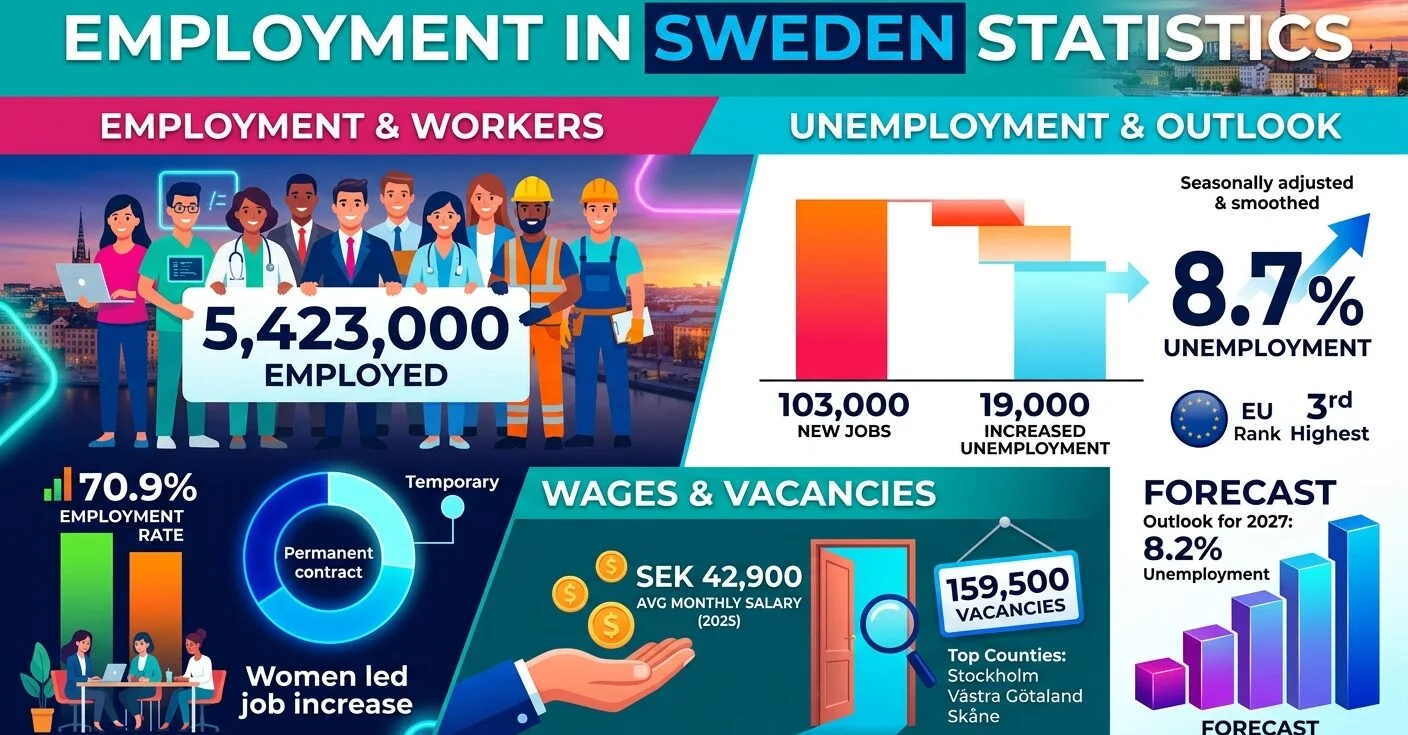
Sweden’s labour force grew by 122,000 people in the year to August 2026, while employment rose by 103,000, according to Statistics Sweden (SCB). Unemployment increased by 19,000 as a result. These employment in Sweden statistics cover job totals, jobless rates by group and county, EU rankings, salaries, vacancies and the September 2026 forecast from Konjunkturinstitutet (KI).
Employment in Sweden Statistics
5,423,000 at Work: Employment in Sweden in August 2026
SCB counted 5,423,000 employed people aged 15–74 in August 2026, before seasonal adjustment. The employment rate reached 70.9%, up 1.2 points on August 2025.
Women took 61,000 of the 103,000 additional jobs. SCB statistician Felicia Holm said women were the main driver of the increase.
| Persons aged 15–74 | August 2025 | August 2026 | Change |
|---|---|---|---|
| Labour force | 5,806,000 | 5,928,000 | +122,000 |
| Employed | 5,320,000 | 5,423,000 | +103,000 |
| Employees | 4,805,000 | 4,944,000 | +138,000 |
| Permanent employees | 4,117,000 | 4,207,000 | +89,000 |
| Temporary employees | 688,000 | 737,000 | +49,000 |
| Unemployed | 486,000 | 505,000 | +19,000 |
SCB classes the gains in employed people, employees and permanent employees as statistically significant. The rises in temporary staff and unemployment fall short of its threshold.
Permanent contracts covered 4,207,000 of the 4,944,000 employees; 737,000 worked on temporary contracts.
Seasonally adjusted and smoothed data put employment at 5,321,000 and the employment rate at 69.6%, against 69.0% in August 2025.
Why Did Swedish Unemployment Rise While 103,000 Jobs Were Added?
Employment grew by 103,000 and unemployment by 19,000 between August 2025 and August 2026, together adding 122,000 people to the labour force.
Unemployment reached 505,000 in August 2026, or 8.5% of the labour force. The rate was 8.9% for women and 8.2% for men.
Seasonal adjustment and smoothing give 8.7%, or 509,000 people. SCB advises against comparing the adjusted and unadjusted series.
Long-term joblessness eased: people out of work for 27 weeks or more fell by 36,000 to 168,000.
Underemployment adds to the slack. SCB counted 395,000 underemployed workers, 7.3% of the employed, and unused labour supply of 27.0 million hours a week, equal to 675,000 full-time jobs.
A labour force growing faster than unemployment falls also appears in these employment in Spain statistics.
Swedish Unemployment Rate by Sex, 2024–2026
Men’s adjusted rate moved above women’s in mid-2025 and held at 9.0% from October to December. Both stood at 8.7% in August 2026.
| Month | Total | Men | Women |
|---|---|---|---|
| Aug 2024 | 8.5% | 8.3% | 8.7% |
| Dec 2024 | 8.6% | 8.4% | 8.9% |
| Apr 2025 | 8.8% | 8.6% | 8.9% |
| Aug 2025 | 8.8% | 8.9% | 8.7% |
| Dec 2025 | 8.8% | 9.0% | 8.6% |
| Apr 2026 | 8.7% | 8.8% | 8.6% |
| Aug 2026 | 8.7% | 8.7% | 8.7% |
Employment in Sweden Statistics vs the EU and Nordic Neighbours
Sweden’s 8.7% rate ranked third-highest among the 27 EU member states in August 2026. Finland led at 10.3% and Spain followed at 10.0%; the EU rate was 6.1%.
| Country or area | August 2025 | August 2026 |
|---|---|---|
| Finland | 9.9% | 10.3% |
| Spain | 10.5% | 10.0% |
| Sweden | 8.8% | 8.7% |
| France | 7.8% | 8.2% |
| Estonia | 7.2% | 8.0% |
| Euro area | 6.3% | 6.4% |
| EU | 6.0% | 6.1% |
| Denmark | 6.5% | 5.9% |
| Norway | 4.6% | 4.5% |
| Germany | 3.8% | 4.0% |
| Netherlands | 3.9% | 4.0% |
Eurostat uses the trend component for Sweden, Finland, Germany, the Netherlands and Norway. Its count of 509,000 unemployed in Sweden matches SCB’s adjusted figure.
France rose from 7.8% to 8.2%; sector and wage detail sits in these French employment statistics.
The Netherlands posted 4.0%, level with Germany, and its job market is profiled in these Dutch labour market figures.
Youth Unemployment in Sweden: 23.8% or 18.4%?
Eurostat put Sweden’s seasonally adjusted youth rate at 23.8% in August 2026, covering 174,000 people aged 15–24. Estonia, at 28.4%, was the one member state with August data above it.
SCB’s unadjusted figure for the same month was 18.4%, or 144,000 people. Both measures follow the ILO definition, which counts students looking for work as unemployed.
Full-time students made up 102,000 of the 170,000 unemployed young people in 2025, when the annual youth rate was 24.3%.
Who Faces the Highest Unemployment in Sweden?
Foreign-Born vs Swedish-Born Workers, 2025
| Group, ages 15–74 | Unemployment rate, 2025 |
|---|---|
| Foreign-born women | 17.1% |
| Foreign-born, all | 16.4% |
| Foreign-born men | 15.7% |
| Swedish-born men | 6.4% |
| Swedish-born, all | 6.2% |
| Swedish-born women | 5.9% |
Foreign-born people accounted for 248,000 of the 510,000 unemployed in 2025. Their participation rate of 79.2% topped the 74.5% for people born in Sweden.
The employment rate was 66.3% among the foreign-born and 69.9% among the Swedish-born.
Foreign workers’ share of jobs in Germany is broken down in these German employment statistics.
Registered Unemployment by Group and County, August 2026
Arbetsförmedlingen counted just over 349,000 registered unemployed at the end of August 2026, 6.5% of the register-based labour force and close to 22,000 fewer than a year earlier.
| Registered unemployed | August 2025 | August 2026 |
|---|---|---|
| All | 7.0% | 6.5% |
| Women | 7.0% | 6.6% |
| Men | 7.1% | 6.5% |
| Foreign-born | 15.1% | 13.4% |
| Swedish-born | 4.4% | 4.2% |
| Ages 18–24 | 8.4% | 7.8% |
Every county recorded a fall. Skåne had the highest rate at 8.4%, followed by Södermanland (8.2%), Västmanland (7.9%) and Gävleborg (7.7%); Norrbotten had the lowest at 3.4%.
The 2026 register covers ages 16–66, against 16–65 in 2025. Arbetsförmedlingen’s figures are not part of Sweden’s official statistics.
SEK 42,900 a Month: Average Salary in Sweden by Sector, 2025
The average monthly salary across all sectors was SEK 42,900 in 2025, up from SEK 41,600 in 2024. Salaried employees in the private sector earned the most, at SEK 53,600.
| Sector (SEK per month) | 2024 | 2025 |
|---|---|---|
| All sectors | 41,600 | 42,900 |
| Salaried employees, private sector | 52,000 | 53,600 |
| Regions | 44,900 | 46,700 |
| Central government | 44,800 | 46,300 |
| Private sector | 42,500 | 43,700 |
| Public sector | 39,500 | 41,000 |
| Municipalities | 36,100 | 37,400 |
| Workers, private sector | 33,200 | 34,200 |
Half of employees earned less than the SEK 38,300 median, while the top 10% earned at least SEK 61,700. Women’s average pay was 90% of men’s, falling to 86% at the 90th percentile.
| SEK per month, 2025 | Women | Men | All |
|---|---|---|---|
| 10th percentile | 27,400 | 28,800 | 28,000 |
| 25th percentile | 31,000 | 33,200 | 32,000 |
| Median | 36,800 | 39,900 | 38,300 |
| 75th percentile | 45,500 | 50,600 | 48,000 |
| 90th percentile | 57,000 | 66,100 | 61,700 |
| Average | 40,600 | 45,100 | 42,900 |
Employees earning SEK 55,000 or more made up 15% of the total, and 37% of that group were women.
EU progress on the Pay Transparency Directive is tracked in these salary transparency statistics.
Open Jobs in Sweden: 159,500 Vacancies in Q2 2026
Employers reported 159,500 vacancies in the second quarter of 2026, 8% more than a year earlier. SCB notes the difference falls inside its margin of error.
That equals 2.9 vacancies per 100 jobs, against 2.7 in Q2 2025, when the total was 147,500.
The business sector held 122,400 openings and public administration 31,900. Employers wanted an immediate start for 106,100 posts.
Stockholm, Västra Götaland and Skåne held more than half of all vacancies. Relative to jobs, Jämtland ranked first at 8.1 per 100, though SCB’s published range for the county runs from 0.7 to 15.5.
| County | Vacancies per 100 jobs | Minimum | Maximum |
|---|---|---|---|
| Jämtland | 8.1 | 0.7 | 15.5 |
| Gotland | 4.9 | 0.2 | 9.6 |
| Gävleborg | 3.7 | 1.6 | 5.8 |
| Kalmar | 3.5 | 2.3 | 4.7 |
| Uppsala | 2.2 | 1.8 | 2.6 |
| Halland | 2.0 | 1.5 | 2.5 |
| Kronoberg | 1.8 | 1.3 | 2.3 |
| Blekinge | 1.7 | 1.1 | 2.3 |
What Is the Outlook for Employment in Sweden in 2027?
Konjunkturinstitutet forecasts unemployment of 8.7% in 2026 and 8.2% in 2027 in its September 2026 report. Its August update had 8.6% and 7.9%.
KI’s 2028 figure moved to 7.3% from 7.2%, and its 2027 employment growth forecast dropped to 0.7% from 1.3%.
Productivity has driven much of the recovery so far, KI says, so the labour market has lagged. It expects demand for labour to gain pace in 2027.
| KI forecast, annual % change | 2026 | 2027 |
|---|---|---|
| GDP, market prices | 3.0 | 2.4 |
| Employment | 0.7 | 0.7 |
| Hours worked, calendar-adjusted | 0.2 | 0.7 |
| Productivity, calendar-adjusted | 2.4 | 1.4 |
| Hourly wages | 3.5 | 3.4 |
| KPIF inflation | 1.6 | 2.6 |
Arbetsförmedlingen’s June 2026 forecast puts registered unemployment at an average of 349,000 (6.5%) in 2026 and 328,000 (6.1%) in 2027.
FAQs
What is the employment rate in Sweden?
70.9% of people aged 15–74 were employed in August 2026 before seasonal adjustment, up 1.2 points on a year earlier. The seasonally adjusted and smoothed rate was 69.6%, according to SCB.
What is the unemployment rate in Sweden in 2026?
Sweden’s rate was 8.5% in August 2026 without seasonal adjustment and 8.7% after it, SCB reports. Eurostat’s 8.7% for the same month ranked third-highest in the EU.
Why is unemployment so high in Sweden?
SCB data show the labour force grew by 122,000 in the year to August 2026, outpacing 103,000 new jobs, and foreign-born unemployment stood at 16.4% in 2025. KI says the labour market has lagged a productivity-led recovery.
What is the average salary in Sweden?
SEK 42,900 a month in 2025 across all sectors, per SCB. The median was SEK 38,300, with men averaging SEK 45,100 and women SEK 40,600.
Is Sweden’s youth unemployment overstated, as Reddit threads often claim?
The rate follows ILO rules, which count students seeking work as unemployed. In 2025, 102,000 of Sweden’s 170,000 unemployed 15–24-year-olds were full-time students, and the youth rate was 24.3%, according to SCB.
Sources
https://ec.europa.eu/eurostat/web/products-euro-indicators/w/3-01102026-ap
https://mb.cision.com/Public/1326/4396070/9d34e2eadb908f6f.pdf
