

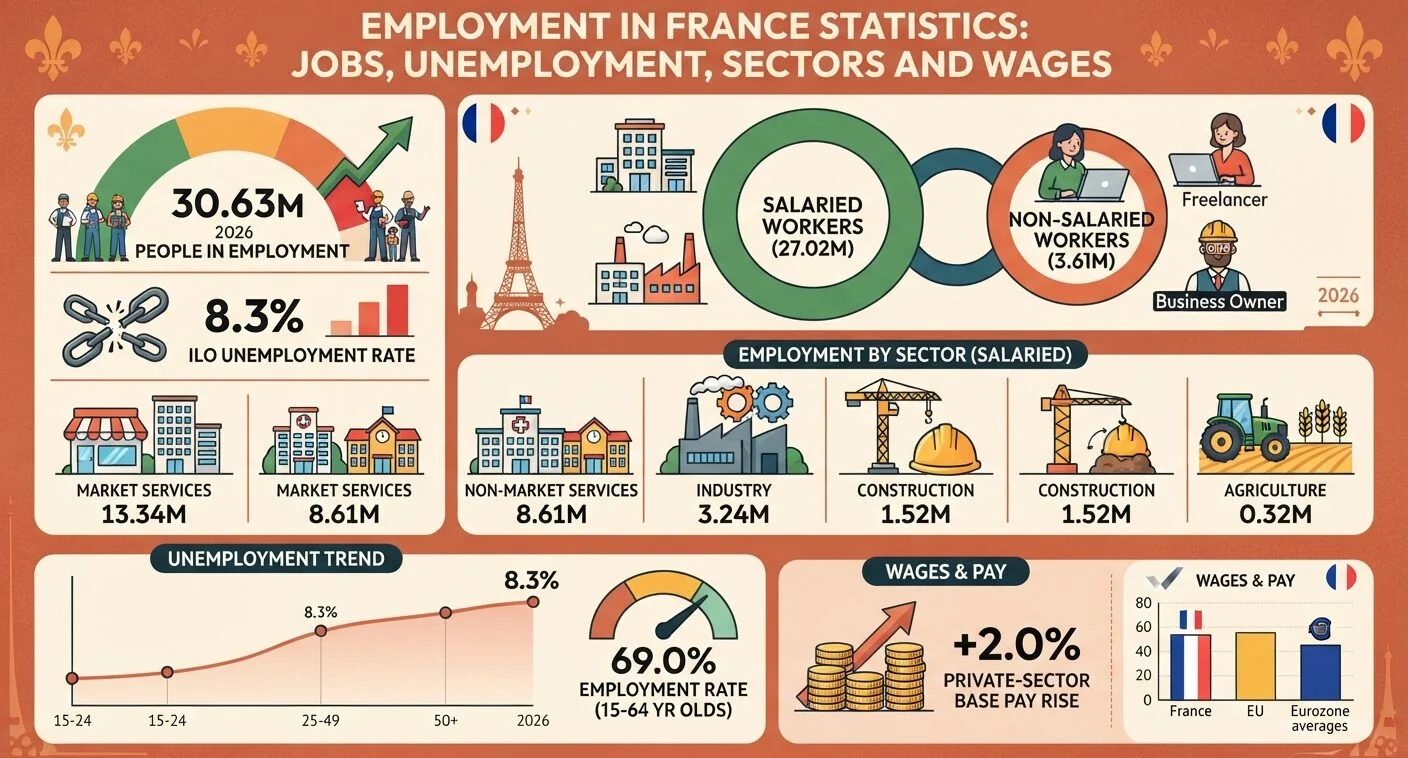
France had 30,626,300 people in work at the end of June 2026, while ILO unemployment climbed to 8.3%. This page tracks employment in France statistics from INSEE, Dares and Eurostat releases published between July and September 2026: jobs by sector, age and contract, the jobless rate, base pay and France’s position within the EU.
Employment in France Statistics
How Many People Work in France in 2026?
INSEE counted 30,626,300 people in employment at the end of Q2 2026, up 10,000 on the quarter and 47,000 on the year. The estimate is seasonally adjusted and covers France excluding Mayotte.
Salaried jobs fell by 23,500 to 27,021,100. Non-salaried work rose by 33,500 to 3,605,200, which kept the total flat.
| Employment type | Level, end Q2 2026 | Quarterly change | Annual change |
|---|---|---|---|
| Salaried | 27,021,100 | -23,500 (-0.1%) | -72,500 (-0.3%) |
| Non-salaried | 3,605,200 | +33,500 (+0.9%) | +119,500 (+3.4%) |
| Total | 30,626,300 | +10,000 (0.0%) | +47,000 (+0.2%) |
Source: INSEE, Informations Rapides n° 214, Q2 2026 (published 28 August 2026)
INSEE labels the latest non-salaried figure experimental, because current-quarter micro-entrepreneur numbers are extrapolated from business creations. For the US side of independent work, see these freelancer statistics.
Salaried employment still sits 1.2 million jobs (+4.7%) above its end-2019 level.
Source: INSEE, Informations Rapides n° 214, Q2 2026
Employment in France by Sector, Q2 2026
| Sector (salaried jobs) | Jobs, end Q2 2026 | Quarterly change | Annual change |
|---|---|---|---|
| Market services | 13,336,600 | -8,600 (-0.1%) | -31,000 (-0.2%) |
| Non-market services | 8,609,200 | +2,800 (0.0%) | +7,600 (+0.1%) |
| Industry | 3,240,600 | -2,600 (-0.1%) | -15,100 (-0.5%) |
| Construction | 1,519,400 | -6,700 (-0.4%) | -21,600 (-1.4%) |
| Agriculture | 315,300 | -8,400 (-2.6%) | -12,300 (-3.8%) |
| Total | 27,021,100 | -23,500 (-0.1%) | -72,500 (-0.3%) |
Source: INSEE, Informations Rapides n° 214, Q2 2026 (end-of-quarter, seasonally adjusted)
Market services lead with 13,336,600 jobs; INSEE books every temporary agency worker here, whatever sector hosts the assignment. Agriculture posted the steepest quarterly drop, and INSEE points to vine-related activity.
Temporary agency jobs fell 1.0% in the quarter to 699,500, 9.9% below end-2019. Information and communication lost 16,100 jobs (-1.8%) over the year, while hotels and restaurants added 4,400 in the quarter.
Wider data on changing knowledge-work hiring sits in these future of work statistics.
Private vs Public Payrolls
The private sector employed 20,957,000 salaried workers and the public sector 6,064,100. Private payrolls shrank by 80,900 (-0.4%) over the year, the sixth straight quarter of annual decline, while public jobs rose 8,500 (+0.1%).
Source: INSEE, Informations Rapides n° 214, Q2 2026
What Is the Unemployment Rate in France?
France’s ILO unemployment rate reached 8.3% in Q2 2026, its highest since Q3 2020. INSEE counted 2,677,000 unemployed, 62,000 more than in Q1 and 261,000 more than a year earlier.
The rate stood at 7.4% in Q4 2024. It remains 2.2 points below its mid-2015 peak, and INSEE gives a margin of plus or minus 0.3 point.
| Unemployment rate (% of group’s labour force) | Q1 2026 | Q2 2026 |
|---|---|---|
| All aged 15+ | 8.1% | 8.3% |
| Aged 15-24 | 21.2% | 21.6% |
| Aged 25-49 | 7.3% | 7.5% |
| Aged 50+ | 5.2% | 5.5% |
| Men | 8.5% | 8.5% |
| Women | 7.8% | 8.2% |
| Long-term (1 year+) | 2.0% | 2.1% |
Source: INSEE, Informations Rapides n° 192, Q1 and Q2 2026 (published 7 August 2026)
Why Is Unemployment Rising in France?
INSEE attributes 0.44 point of the 0.98-point rise since end-2024 to RSA recipients and young France Travail registrants, the two groups targeted by the full employment law. It calls these accounting contributions that cannot separate the law’s effect from the economic cycle.
Participation stays high. The 15-64 activity rate was 75.4% in Q2, after a record 75.5% in Q1, the highest since INSEE began measuring in 1975.
Long-term unemployment covered 671,000 people, 116,000 more than a year earlier. The halo around unemployment, people who want work but are not counted as unemployed, stood at 1,865,000.
Source: INSEE, Informations Rapides n° 192, Q2 2026
Registered Jobseekers at France Travail
Category A jobseekers, registrants with no work at all, rose 0.8% (+27,900) in Q2 2026 in France excluding Mayotte. On the series corrected for automatic registrations and the new sanctions rules, category A fell 1.6% (-38,000) over the year.
Registrations are an administrative count, so they do not match the ILO survey measure.
Source: France Travail and Dares, STMT, Q2 2026
69.0% of 15-64 Year Olds in Work: Employment Rate in France by Age
69.0%
Employment rate, ages 15-64, Q2 2026
The 15-64 employment rate slipped 0.3 point in Q2 2026 and 0.5 point on the year. Every broad age band posted a lower rate than in Q2 2025.
Among seniors, only 60-64 year olds kept climbing: their employment rate rose 1.2 points in a year to 45.8%. The 50-64 activity rate hit 73.2%, the highest since 1975.
Source: INSEE, Labour Force Survey, Q2 2025 and Q2 2026
Private-Sector Jobs by Age Group
| Age group | Private salaried jobs, end Q2 2026 | Annual change |
|---|---|---|
| 15-29 | 5,124,000 | -72,300 (-1.4%) |
| 30-54 | 11,862,900 | -114,000 (-1.0%) |
| 55 and over | 3,970,100 | +105,400 (+2.7%) |
Source: INSEE, Informations Rapides n° 214, Q2 2026
INSEE ties the youth decline mainly to fewer work-study contracts. Women held 9,439,100 private jobs and men 11,517,900.
Contract Types in French Private Employment
Permanent contracts cover 17,326,200 private-sector jobs, down 0.2% on the year. Work-study contracts dropped 4.7% but remain 56.4% above their end-2019 level.
| Contract | Jobs, end Q2 2026 | Annual change |
|---|---|---|
| Permanent | 17,326,200 | -31,800 (-0.2%) |
| Fixed-term (excl. work-study) | 1,836,300 | +9,900 (+0.5%) |
| Work-study | 993,000 | -49,200 (-4.7%) |
| Temporary agency | 699,500 | -12,400 (-1.7%) |
| Other contracts | 102,000 | +2,600 |
Source: INSEE, Informations Rapides n° 214, Q2 2026
Part-time work made up 17.8% of employment in Q2 2026, and 4.4% of workers were underemployed. Average hours per job held at 31.1 a week.
Source: INSEE, Labour Force Survey, Q2 2026
Are Wages in France Rising Faster Than Prices?
Dares measured private-sector base monthly pay up 0.7% in Q2 2026 and 2.0% over the year, after 1.7% in Q1. The index tracks base salary only, without bonuses or overtime.
Source: Dares, Acemo survey, Q2 2026 (final results, September 2026)
INSEE’s consumer price index rose 1.8% over the year to June 2026.
Source: INSEE, consumer price index, June 2026
For a cross-Atlantic reference, pay growth figures sit in these US employment statistics.
Dares put the private-sector job vacancy rate at 2.3% in Q2 2026, excluding agriculture, temp agencies and household employers. An average of 40,000 employees were on short-time work, 7% fewer than in Q2 2025.
Source: Dares, Q2 2026
How often French job ads state pay is tracked in these salary transparency statistics.
France vs the EU: Where Employment in France Statistics Stand
Eurostat put France’s unemployment rate at 8.3% in July 2026, against 6.4% for the euro area and 6.1% for the EU. Finland (10.5%), Spain (10.0%) and Sweden (8.7%) ranked higher.
France stood at 7.7% in July 2025 on the same series. Its under-25 rate was 20.7% in July 2026, against 15.1% across the EU.
Germany recorded 4.0%, and the breakdown sits in these Germany labour market figures. Eurostat uses trend data for Germany, the Netherlands and Finland.
Spain’s 10.0% reading is unpacked in this Spain jobs data.
Source: Eurostat, Euro indicators, July 2026 (published 1 September 2026)
When Is the Next INSEE Employment Update?
| Q3 2026 release | Date |
|---|---|
| Flash private payroll estimate | 30 October 2026 |
| ILO unemployment and labour market indicators | 10 November 2026 |
| Detailed employment estimate | 27 November 2026 |
Source: INSEE, Informations Rapides n° 192 and n° 214, 2026
Revisions have been small. The Q2 private payroll flash was confirmed at -0.1% with a 5,000-job revision, while Q1 non-salaried growth was revised up 0.4 point (+15,400 jobs).
Source: INSEE, Informations Rapides n° 214, Q2 2026
FAQs
How many people work in France?
France had 30,626,300 people in work at the end of June 2026, per INSEE’s estimate for France excluding Mayotte. That splits into 27,021,100 salaried jobs and 3,605,200 non-salaried workers.
What is the unemployment rate in France in 2026?
It was 8.3% in Q2 2026 under the ILO definition, up 0.2 point on the quarter and 0.7 point on the year. INSEE counted 2,677,000 unemployed, the highest rate since Q3 2020.
What is the employment rate in France?
INSEE puts it at 69.0% for 15-64 year olds in Q2 2026, down 0.3 point from Q1. The rate was 33.8% for 15-24s, 82.4% for 25-49s and 69.1% for 50-64s.
Which sector employs the most people in France?
Market services, with 13,336,600 salaried jobs at the end of Q2 2026. Non-market services follow with 8,609,200, then industry with 3,240,600, based on INSEE’s detailed employment estimate.
Is it hard to find a job in France, as many Reddit threads suggest?
Official data point to a softer market. Unemployment reached 8.3% in Q2 2026, with 671,000 people searching for a year or more (INSEE). Dares put the private-sector job vacancy rate at 2.3%.
Sources
https://www.insee.fr/fr/statistiques/9039152
https://www.insee.fr/fr/statistiques/9032359
https://ec.europa.eu/eurostat/web/products-euro-indicators/w/3-01092026-bp
