

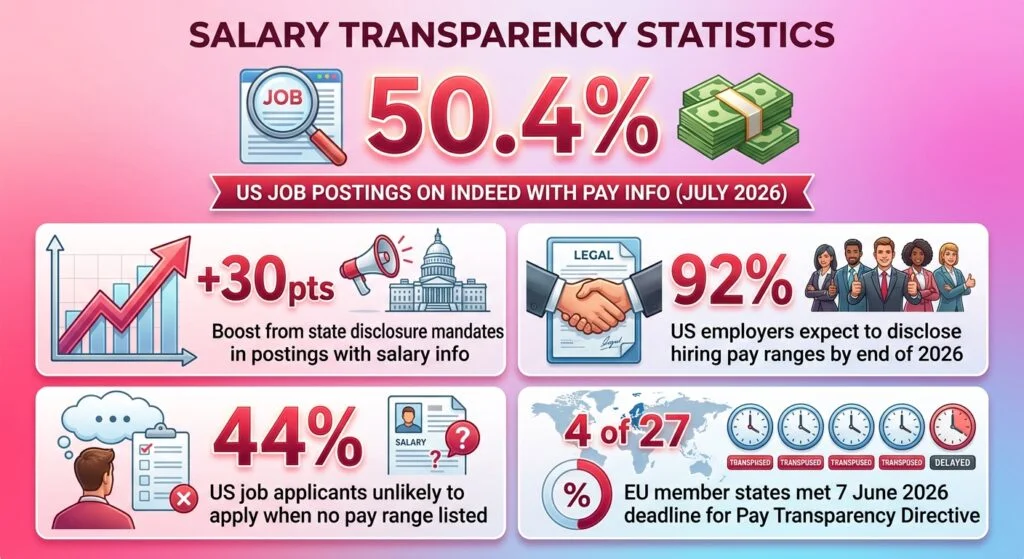
Half of all US job postings now name a salary. 50.4% of US postings on Indeed carried explicit wage or salary information in July 2026, the highest monthly reading in a series that starts in January 2020. This page collects salary transparency statistics by country, sector and law, plus what employers and applicants report doing about it. Every figure carries its measurement and period.
Key Salary Transparency Statistics
How Many US Job Postings Include Salary Transparency?
Indeed’s Pay Transparency Tracker measures the monthly share of postings on Indeed that contain explicit wage or salary information. The US share hit 50.4% in July 2026.
The annual gain has narrowed three years running. Postings gained 6.4 points in the year to July 2024, 2.6 points to July 2025, and 1.9 points to July 2026.
| Month | Share of US postings with pay information | Year-on-year change |
|---|---|---|
| July 2023 | 39.5% | — |
| July 2024 | 45.9% | +6.4 points |
| July 2025 | 48.5% | +2.6 points |
| July 2026 | 50.4% | +1.9 points |
Source: Indeed Hiring Lab, Pay Transparency Tracker, July 2023 to July 2026.
What Do Disclosure Laws Actually Change?
A National Bureau of Economic Research working paper released in November 2025 studied state policies requiring salary information in postings. Using a difference-in-differences design, the authors found employers raised the fraction of postings with salary information by 30 percentage points, with wage increases of 1.3% to 3.6% across three datasets.
Colorado shows the scale and the ceiling. Roughly 35% of Colorado postings carried salary information before the January 2021 law; the figure reached almost 70% a year after it took effect, and the authors record substantial non-compliance. The same paper found no measured impact on employment, posting volume, or skill requirements. Disclosure now moves with legislatures rather than employer preference, one of several structural shifts visible in wider workplace data for 2026.
Source: NBER Working Paper 34480, published November 2025.
Salary Transparency Statistics By Country
Japan leads the eight countries in Indeed’s tracker at 96.8% of postings in July 2026, where naming pay is long-standing hiring practice rather than recent reform. Germany sits last at 14.1%.
Canada added 14.1 points in two years, more than any other country in the set. British Columbia legislated in 2023, and Ontario’s rule took effect on 1 January 2026, requiring employers with 25 or more employees to state expected compensation in publicly advertised postings, with any posted range capped at $50,000.
| Country | July 2024 | July 2026 | Change |
|---|---|---|---|
| Japan | 97.4% | 96.8% | -0.6 points |
| United Kingdom | 63.9% | 59.6% | -4.3 points |
| Canada | 42.9% | 57.0% | +14.1 points |
| United States | 45.9% | 50.4% | +4.5 points |
| France | 43.5% | 43.3% | -0.2 points |
| Ireland | 34.8% | 37.2% | +2.4 points |
| Australia | 32.0% | 29.5% | -2.5 points |
| Germany | 11.9% | 14.1% | +2.2 points |
Source: Indeed Hiring Lab, Pay Transparency Tracker, July 2024 and July 2026.
Four of the eight markets went backwards over the two years. Cross-border hiring keeps some pressure on the laggards, a dynamic also running through current US remote work figures.
Salary Transparency Statistics By US Industry Sector
Disclosure runs inverse to pay level across the 44 US sectors Indeed tracks. Childcare tops the list at 81.0% of postings in July 2026. Pharmacy sits last at 26.3%, with physicians and surgeons next at 32.3%.
Industrial engineering recorded the largest two-year gain of any sector at 13.1 points. Driving fell furthest, dropping 9.0 points to 59.9%.
| Sector | July 2024 | July 2026 | Change |
|---|---|---|---|
| Childcare | 77.1% | 81.0% | +3.9 points |
| Community & Social Service | 62.4% | 67.5% | +5.1 points |
| Legal | 55.2% | 64.1% | +8.9 points |
| Driving | 68.9% | 59.9% | -9.0 points |
| Software Development | 35.7% | 46.9% | +11.2 points |
| Industrial Engineering | 30.6% | 43.7% | +13.1 points |
| Physicians & Surgeons | 27.3% | 32.3% | +5.0 points |
| Pharmacy | 30.6% | 26.3% | -4.3 points |
Source: Indeed Hiring Lab, Pay Transparency Tracker, US sector data, July 2024 and July 2026.
US Salary Transparency Laws By State
Jackson Lewis lists 15 states plus Washington, D.C. with pay transparency obligations as of its 2026 update. Employee-count thresholds are the reason national coverage stalls near half of postings.
Colorado and Washington, D.C. cover employers with a single in-state worker. Hawaii exempts anyone under 50 staff. Connecticut, Nevada and Rhode Island require disclosure on request or after an interview rather than in the advertisement, which keeps those postings outside the Indeed count.
| Jurisdiction | Employer threshold | When disclosure is required |
|---|---|---|
| Colorado | 1+ employee in state | In job postings |
| Washington, D.C. | 1+ employee | In job listings |
| New York | 4+ employees | In job postings |
| Vermont | 5+ employees | In job advertisements |
| New Jersey | 10+ employees | In job postings |
| California | 15+ employees | In job postings; on request |
| Illinois | 15+ employees | In job postings |
| Washington | 15+ employees | In job postings |
| Massachusetts | 25+ employees | In job postings; on request |
| Delaware | 26+ employees | In job postings (effective Sept. 26, 2027) |
| Minnesota | 30+ employees | In job postings |
| Hawaii | 50+ employees | In job postings |
| Connecticut | All employers | On request or before offer |
| Nevada | All employers | After interview; on request |
| Rhode Island | All employers | On request; at hire |
Source: Jackson Lewis, “Navigating 2026: Pay Transparency Laws and Employer Obligations,” 2026.
California’s SB 642 took effect on 1 January 2026, clarifying how pay scale is defined. Maryland also requires wage ranges in postings, with coverage set by the posting rather than an employee count.
EU Pay Transparency Directive Statistics
Member states had until 7 June 2026 to transpose the directive. Four met it: Italy, Lithuania, Malta and Slovakia, according to Lewis Silkin. Greece followed on 6 July 2026.
The directive requires employers with more than 100 workers to report gender pay gap data. Where a gap of 5% or more appears in a job category and cannot be explained by objective factors, the employer has six months to close it before a joint pay assessment with employee representatives is triggered.
| Member state | Status | Date |
|---|---|---|
| Italy, Lithuania, Malta, Slovakia | Transposed | By 7 June 2026 deadline |
| Greece | Transposed (Law no. 5316) | Published 6 July 2026 |
| Estonia | Partially transposed | In force 13 July 2026 |
| Spain | Draft published | 3 August 2026 |
| Portugal | Draft published | 5 August 2026 |
| France | Draft; vote expected early 2027 | Status as of 29 June 2026 |
| Germany | Initial steps | Bundestag notice, 16 July 2026 |
Source: Ius Laboris transposition tracker, updated 20 August 2026; Lewis Silkin, June 2026.
Germany’s 14.1% posting disclosure rate and France’s 43.3% both sit inside the delayed group, so the directive has yet to register in European job advertisements.
Employer Salary Transparency Statistics
Mercer surveyed 285 US-headquartered organizations online between September and October 2025, part of more than 1,600 responses across 60 markets. Employers comply at the posting level and leave internal pay communication unfinished.
| Measure | Share of US organizations |
|---|---|
| Expect to disclose hiring pay ranges by end of 2026 | 92% |
| Same measure, 2024 | 83% |
| Prepared to meet compliance requirements, 2025 | 54% |
| Same measure, 2024 | 39% |
| Cite legal requirements as a driver | 93% |
| Have fully implemented an enterprise-wide approach | 17% |
| Have protocols for external pay inquiries | 13% |
Source: Mercer, 2026 Global Pay Transparency Survey, US results, fielded September to October 2025.
Payscale’s 2026 Compensation Best Practices Report puts 49% of organizations targeting organization-wide or fully public pay transparency in 2026, up from 33% in 2025. In the same report, 57% say they post salary ranges in job ads, 23% call themselves fully prepared for the EU directive, and 40% believe unverified data sources are driving unfair pay perceptions.
Measured outcomes have not followed. The Economic Policy Institute found women were paid 18.6% less than men on an hourly basis in 2025, after controlling for race and ethnicity, education, age, marital status and state, up from a series low of 18.0% in 2024.
Source: Payscale, 2026 Compensation Best Practices Report, February 2026; Economic Policy Institute, 2025 data.
Job Seeker Salary Transparency Statistics
Patriot Software surveyed 1,000 US adults who had applied for at least one job in the previous 12 months, fielded via Pollfish in January 2026. Attitudes run well ahead of behaviour.
84% attribute a negotiating motive to employers who stay quiet on pay, but only 44% say a missing range stops them applying. Among those who did see a posted range, 17% received an offer below it. Independent workers price their own rates outside this system entirely, a contrast set out in these freelance market figures.
| Finding | Share of respondents |
|---|---|
| Say pay transparency affects whether they feel valued | 90% |
| Say companies hide pay to weaken candidate negotiating power | 84% |
| Consider withholding pay disrespectful to applicants | 45% |
| Unlikely to apply without a listed pay range | 44% |
| Believe employers listing pay upfront are more honest than average | 44% |
| Received an offer below the posted range | 17% |
Source: Patriot Software pay transparency hiring survey, fielded January 2026, 1,000 US respondents.
Gen Z respondents were the group most focused on how pay is set, at 42%. Application behaviour keeps shifting alongside hybrid work adoption and return-to-office policy, both of which change which postings a candidate can realistically take.
FAQ
What percentage of job postings show salary in 2026?
50.4% of US job postings on Indeed contained explicit pay information in July 2026, up from 45.9% in July 2024. Japan leads the eight countries Indeed tracks at 96.8%; Germany trails at 14.1%.
Reddit job seekers often ask whether posted pay ranges are honest. What does the data show?
Patriot Software found 17% of applicants who saw a posted range received an offer below it, in a January 2026 survey of 1,000 US applicants. NBER also recorded substantial non-compliance with Colorado’s posting law.
Do salary transparency laws raise wages?
An NBER working paper published in November 2025 found state disclosure mandates raised wages 1.3% to 3.6% across three datasets, and lifted the share of postings with salary information by 30 percentage points.
Do employers treat pay data shared on Reddit and similar forums as a problem?
Mercer lists employee forums among the channels making pay comparable across employers. Payscale found 40% of organizations believe unverified data sources are driving unfair pay perceptions, in its February 2026 report.
Which US states require salary ranges in job postings?
Jackson Lewis lists 15 states plus Washington, D.C. Thresholds range from a single employee in Colorado and D.C. to 50 in Hawaii. Delaware’s rule takes effect 26 September 2027.
Sources
https://github.com/hiring-lab/pay-transparency
https://www.nber.org/papers/w34480
https://www.mercer.com/en-us/about/newsroom/only-half-of-us-employers-are-prepared-to-meet-pay-transparency-compliance-guidelines/
https://www.jacksonlewis.com/insights/navigating-2026-pay-transparency-laws-and-employer-obligations
