

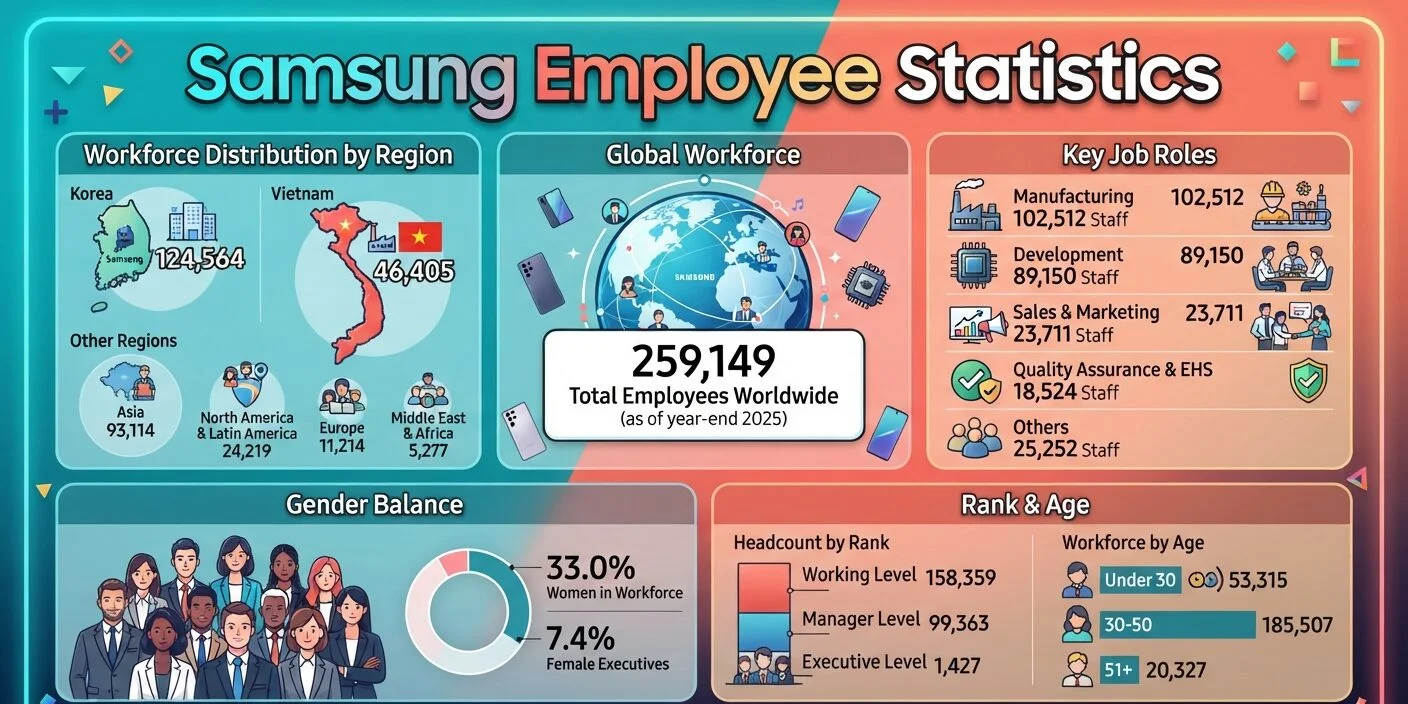
Samsung Electronics counted 259,149 employees worldwide at the end of 2025, and 46,405 of them worked in Vietnam. These Samsung employee statistics break the headcount down by country, job type, rank, age and gender, then cover pay and the 2026 union count, using Samsung’s own ESG disclosures and Korean business reporting.
Samsung Employee Statistics
How Many Employees Does Samsung Have in 2026?
Samsung Electronics reported 259,149 employees at the end of 2025, its latest annual count. The total stood at 262,647 a year earlier and 267,860 at the end of 2023.
Korea accounted for 124,564 of the 2025 total. The other 134,585 sit on the “Global” line of Samsung’s ESG data, and the two lines add up to the company total.
Open-ended contracts dominate: 255,734 non-fixed-term employees against 3,415 fixed-term employees in 2025.
Source: Samsung Electronics ESG Facts & Figures, year-end 2023 to 2025
The count excludes workers dispatched by partner companies, employees on leave, interns and full-time students. A separate line lists 64,216 non-Samsung Electronics employees in 2025, covering people hired or dispatched by partner companies and interns.
Alphabet runs a smaller workforce than Samsung, as the Google headcount breakdown shows.
Source: Samsung Electronics ESG Facts & Figures, 2025
Why do Korean headcount figures differ?
Three published Korea counts sit close together but measure different things. Samsung’s ESG data puts Korea at 124,564 at year-end 2025.
The Korea Herald used 128,881 Samsung Electronics employees at the end of 2025 to calculate the union majority threshold. Separately, the Korea CXO Institute counted 125,580 National Pension enrollees in Q1 2026, as reported by The Korea Herald.
For a chipmaker that cut deeper during 2025, see Intel’s workforce figures.
Source: Samsung Electronics ESG Facts & Figures, 2025; The Korea Herald, June 5, 2026 and May 19, 2026
Samsung Employee Statistics by Country: Vietnam Holds 46,405
Vietnam had 46,405 Samsung Electronics employees at the end of 2025, the largest country headcount outside Korea. India followed with 20,821 and China Mainland with 16,333.
The USA ranked fourth outside Korea at 11,770. Mexico (6,248), Brazil (4,702) and Poland (4,212) were the only other countries above 4,000.
Samsung publishes this country table alongside its report, a level of detail IBM’s headcount disclosures do not include.
Source: Samsung Electronics, The Number of Employees in Each Country/Region, end of 2025
| Region | 2023 | 2024 | 2025 |
|---|---|---|---|
| Korea | 120,756 | 125,297 | 124,564 |
| Asia (Southeast Asia, Southwest Asia, China, Japan) | 100,938 | 95,501 | 93,114 |
| North America and Latin America | 27,882 | 25,100 | 24,219 |
| Europe | 12,001 | 11,500 | 11,214 |
| Middle East and Africa | 4,672 | 4,461 | 5,277 |
| CIS | 1,611 | 788 | 761 |
Source: Samsung Electronics ESG Facts & Figures, employees by region, year-end 2023 to 2025
Middle East and Africa was the only region to add staff between 2024 and 2025, rising from 4,461 to 5,277. CIS headcount fell from 1,611 in 2023 to 761 in 2025.
Job Type Breakdown in Samsung Employee Statistics
| Job type | 2023 | 2024 | 2025 |
|---|---|---|---|
| Manufacturing | 109,722 | 105,571 | 102,512 |
| Development | 83,729 | 88,984 | 89,150 |
| Sales and marketing | 25,136 | 23,466 | 23,711 |
| Quality assurance and EHS | 21,386 | 18,731 | 18,524 |
| Others | 27,887 | 25,895 | 25,252 |
Source: Samsung Electronics ESG Facts & Figures, employees by job type, year-end 2023 to 2025
Manufacturing remained the largest job type at 102,512 employees in 2025, down from 109,722 in 2023. Development rose from 83,729 to 89,150 over the same period.
Quality assurance and EHS fell to 18,524 in 2025. Sales and marketing edged up to 23,711 from 23,466 a year earlier.
Research and development is the largest line of business in Oracle’s employee data, a different mix from Samsung’s.
Headcount by rank
| Rank | 2023 | 2024 | 2025 |
|---|---|---|---|
| Working level | 174,060 | 164,895 | 158,359 |
| Manager level | 92,315 | 96,294 | 99,363 |
| Executive level | 1,485 | 1,458 | 1,427 |
Source: Samsung Electronics ESG Facts & Figures, employees by rank, year-end 2023 to 2025
Manager-level staff rose each year to 99,363 in 2025. Working-level headcount fell to 158,359 and executive-level headcount to 1,427.
Is the Samsung Workforce Getting Older?
Employees under 30 fell from 72,525 in 2023 to 53,315 in 2025. The 51-and-above group grew from 16,803 to 20,327 over the same years.
The 30 to 50 bracket stayed the largest, at 185,507 in 2025. Samsung notes it changed its age-group aggregation criteria to follow global disclosure standards such as GRI and ESRS.
Source: Samsung Electronics ESG Facts & Figures, employees by age group, year-end 2023 to 2025
Retirement rates, 2023 to 2025
Samsung defines its retirement rate as employees who retired during the fiscal year divided by the average number of employees. The Global rate fell from 17.4% in 2023 to 14.2% in 2025, while the Korean rate rose to 2.5%.
| Retirement rate | 2023 | 2024 | 2025 |
|---|---|---|---|
| Total | 10.6% | 10.1% | 8.6% |
| Korean | 2.1% | 2.1% | 2.5% |
| Global | 17.4% | 17.0% | 14.2% |
Source: Samsung Electronics ESG Facts & Figures, retirement rate, fiscal years 2023 to 2025
Women in Samsung’s Workforce: 33.0% of Staff, 7.4% of Executives
Women made up 33.0% of Samsung Electronics employees in 2025, compared with 33.7% in 2023. The share drops at each rank, from 42.1% at working level to 7.4% at executive level.
| Female share by rank | 2023 | 2024 | 2025 |
|---|---|---|---|
| Working level | 42.5% | 41.9% | 42.1% |
| Manager level | 17.6% | 18.2% | 18.9% |
| Executive level | 7.3% | 7.4% | 7.4% |
Source: Samsung Electronics ESG Facts & Figures, percentage of female employees, 2023 to 2025
Development had the lowest female share by job type at 19.9% in 2025, and manufacturing the highest at 41.7%. By region, Middle East and Africa recorded 16.3%, against 43.1% for the Asia region (Southeast Asia, Southwest Asia, China, Japan).
For a US hardware maker’s gender split, see the Apple workforce breakdown.
Source: Samsung Electronics ESG Facts & Figures, female share by job type and region, 2025
Parental leave in Korea
| Employees on parental leave | 2023 | 2024 | 2025 |
|---|---|---|---|
| Men | 1,304 | 1,510 | 2,022 |
| Women | 3,173 | 3,382 | 3,413 |
| Total | 4,477 | 4,892 | 5,435 |
Source: Samsung Electronics ESG Facts & Figures, employees in Korea, 2023 to 2025
Men on parental leave rose from 1,304 in 2023 to 2,022 in 2025. The return-to-work rate after leave was 98.3% for men and 99.4% for women in 2025.
What Do Samsung Employees Earn?
Samsung Electronics paid an average salary of KRW 158 million ($107,300) in 2025, up 21.5% from KRW 130 million in 2024. The Korea Herald, citing the 2025 business report, called it the highest level on record.
SK hynix posted a higher average in 2025, at KRW 185 million against KRW 117 million a year earlier.
| Average employee salary | 2024 | 2025 |
|---|---|---|
| Samsung Electronics | KRW 130 million | KRW 158 million |
| SK hynix | KRW 117 million | KRW 185 million |
Source: The Korea Herald, March 12, 2026 and May 17, 2026, citing 2025 business reports
US chip-sector pay figures sit in NVIDIA’s compensation data for comparison.
Personnel expenses, the sum of wages, retirement benefits and welfare benefits, rose from KRW 38.0 trillion in 2023 to KRW 45.5 trillion in 2025.
Source: Samsung Electronics ESG Facts & Figures, economic value distributed to employees, 2023 to 2025
Samsung also pledged 35.29 million shares to about 130,000 employees under a performance stock unit program introduced in October 2025, averaging around 275 shares per person.
Per-employee ratios depend on whether a company runs its own factories, a point covered in this look at what revenue per employee reveals.
Source: The Korea Herald, March 12, 2026
How many Samsung employees are in the union?
The Samsung Electronics branch of the Samsung Group Employees’ Union had 58,270 members as of 3 p.m. on June 4, 2026. That was down from more than 76,000 at the end of April.
Majority status required at least 64,440 members, based on 128,881 employees at the end of 2025. The drop came after a 2026 wage deal granting the Device Solutions division a special bonus worth 10.5% of operating profit.
Source: The Korea Herald, June 5, 2026
FAQs
How many employees does Samsung have?
Samsung Electronics had 259,149 employees worldwide at the end of 2025, per its ESG data. Korea accounted for 124,564, and 134,585 worked outside Korea.
Which country has the most Samsung employees outside Korea?
Vietnam, with 46,405 employees at the end of 2025. India ranked next at 20,821, followed by China Mainland at 16,333 and the USA at 11,770.
What is the average salary at Samsung Electronics?
KRW 158 million ($107,300) in 2025, according to the 2025 business report cited by The Korea Herald. That was up 21.5% from KRW 130 million in 2024.
What percentage of Samsung employees are women?
Women were 33.0% of employees in 2025. Their share was 18.9% at manager level and 7.4% at executive level, based on Samsung’s ESG data.
Is the Samsung headcount quoted on Reddit accurate?
Check it against filings. Samsung’s ESG data shows 259,149 global and 124,564 Korean employees at end-2025, while Korean reporting cites 128,881 domestic employees and 125,580 pension enrollees in Q1 2026.
Sources
https://www.samsung.com/global/sustainability/digital-library/facts-figures
https://www.koreaherald.com/article/10691935
