

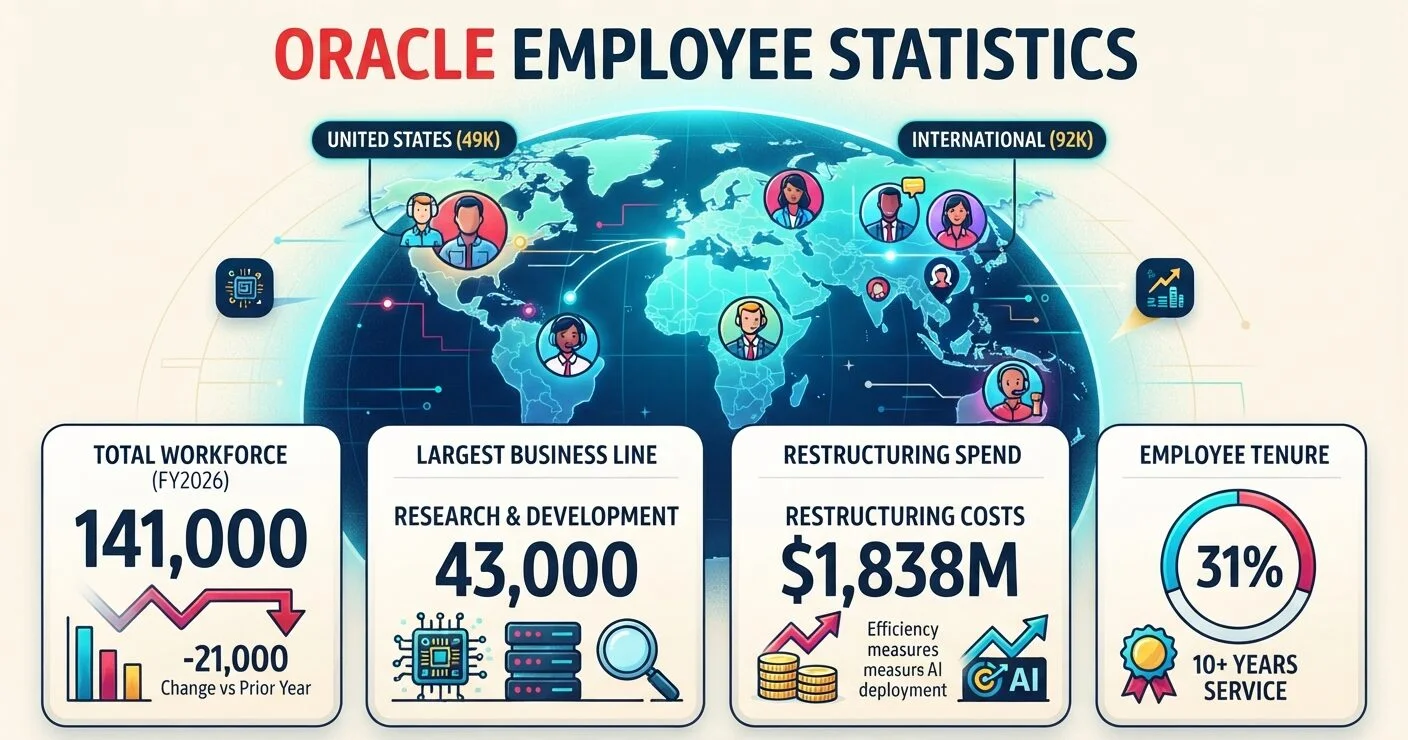
Oracle closed fiscal 2026 with roughly 141,000 full-time employees, down 21,000 in twelve months. Revenue over the same year hit a record $67.4 billion. These Oracle employee statistics cover headcount by line of business, the US and international split, restructuring spend, reported pay, and tenure, drawn from Oracle’s Form 10-K filings and its own earnings tables.
Oracle Employee Statistics: Key Numbers
How Many People Does Oracle Employ in 2026?
Oracle reported approximately 141,000 full-time employees as of May 31, 2026, the last day of its fiscal 2026. The prior two filings put the count at 162,000 and 159,000.
The 2026 figure is a headcount total on a single date, not a count of terminations. Oracle has not published a layoff number for the year.
| Fiscal year (ends May 31) | Full-time employees | Change vs prior year |
|---|---|---|
| 2026 | 141,000 | -21,000 |
| 2025 | 162,000 | +3,000 |
| 2024 | 159,000 | — |
Source: Oracle Form 10-K filings, fiscal years 2024, 2025 and 2026; approximate full-time employee counts as of May 31 each year.
Oracle Employee Statistics by Line of Business
Every one of Oracle’s six reported lines of business shrank in fiscal 2026. Research and development lost the most people in absolute terms, falling from 50,000 to 43,000.
Sales and marketing dropped from 31,000 to 25,000, the steepest decline of the two largest commercial functions. Hardware, at 2,000 employees, is now the smallest line of business by a wide margin.
One label changed between filings. Oracle’s fiscal 2025 10-K lists the 29,000-person group as “Cloud services and license support operations”; the fiscal 2026 filing calls the same business “Cloud and software,” which the 10-K notes was formerly referred to as cloud and license.
| Line of business | FY2026 | FY2025 | Change |
|---|---|---|---|
| Research and development | 43,000 | 50,000 | -7,000 |
| Services | 34,000 | 37,000 | -3,000 |
| Cloud and software | 26,000 | 29,000 | -3,000 |
| Sales and marketing | 25,000 | 31,000 | -6,000 |
| General and administrative | 11,000 | 12,000 | -1,000 |
| Hardware | 2,000 | 3,000 | -1,000 |
Source: Oracle Form 10-K, fiscal 2026 and fiscal 2025; approximate employee counts by lines of business as of May 31, 2026 and May 31, 2025. The FY2025 line reported as “Cloud services and license support operations” appears as “Cloud and software” in FY2026.
Share of the Fiscal 2026 Workforce
The six lines of business together account for the full 141,000. Research and development and services hold more than half of the headcount between them.
Source: Oracle Form 10-K, fiscal 2026; approximate employee counts by lines of business as of May 31, 2026.
Where Are Oracle Employees Based?
About 49,000 Oracle employees worked in the United States as of May 31, 2026, and about 92,000 worked internationally. Both regions shrank, by 9,000 and 12,000 respectively.
International staff have outnumbered US staff in each of the last three filings. Oracle’s 10-K says its international subsidiaries sell, support and service its offerings in their local countries as well as in other countries where it has no direct sales subsidiary. Running engineering and support across that many locations leans on the same distributed arrangements described in US remote work data for 2026, and on the split schedules tracked in the latest hybrid work trends.
| Fiscal year (ends May 31) | United States | International | Total |
|---|---|---|---|
| 2026 | 49,000 | 92,000 | 141,000 |
| 2025 | 58,000 | 104,000 | 162,000 |
| 2024 | 58,000 | 101,000 | 159,000 |
Source: Oracle Form 10-K filings, fiscal years 2024, 2025 and 2026; approximate full-time employee counts as of May 31 each year.
Oracle Layoffs and Restructuring Costs in Fiscal 2026
Restructuring and other expenses came to $1,838 million in fiscal 2026, against $374 million the prior year, an increase Oracle reports at 391%. The fourth quarter alone carried $823 million of that total.
Oracle defines the line as employee severance costs and other exit costs tied to restructuring activities, plus certain asset impairment charges and other operating items. The company’s fiscal 2026 10-K states that adopting and deploying AI technologies across its operations has resulted in workforce reductions and may continue to do so.
Two functions moved in opposite directions on spend. Research and development expense rose 4% to $10,272 million while R&D headcount fell by 7,000; sales and marketing expense fell 4% to $8,331 million alongside a 6,000-person reduction.
| GAAP operating expense ($M) | FY2026 | FY2025 | Change |
|---|---|---|---|
| Cloud and software | 17,597 | 11,569 | +52% |
| Research and development | 10,272 | 9,860 | +4% |
| Sales and marketing | 8,331 | 8,651 | -4% |
| Services | 4,556 | 4,576 | 0% |
| Restructuring and other | 1,838 | 374 | +391% |
| General and administrative | 1,618 | 1,602 | +1% |
| Hardware | 868 | 782 | +11% |
Source: Oracle Q4 Fiscal 2026 Financial Results, condensed consolidated statements of operations, years ended May 31, 2026 and May 31, 2025. Percentages as published by Oracle in US dollars.
Capital expenditures over the same fiscal year reached $55,663 million, up from $21,215 million. For anyone weighing an Oracle offer against the market, the flexibility picture varies sharply by employer, as the return-to-office and remote work data for 2026 shows.
How Much Does Oracle Pay Its Employees?
Levels.fyi reports a median total compensation of $171,719 across all Oracle roles, updated September 13, 2026. These are self-reported submissions from current and former employees, verified against offer letters and W-2s, and describe the people who submitted rather than the whole workforce.
For the software engineer role in the United States, Levels.fyi puts the median at $205,000 and the range from roughly $164,000 at IC-1 to about $1.16 million at IC-7, updated September 12, 2026. Median total compensation at IC-3, titled Senior MTS, is $209,797 on that same page. Engineers pricing a package against their own equipment budget can compare real developer desk setups for a sense of the fixed costs involved.
Oracle’s own accounts show stock-based compensation of $4,811 million in fiscal 2026, up 3% from $4,674 million. Research and development absorbed $2,805 million of that, more than the other five categories combined.
Source: Oracle Q4 Fiscal 2026 Financial Results, stock-based compensation by GAAP operating expense category, year ended May 31, 2026.
The 10-K flags the risk directly: Oracle says its stock price has been volatile in recent periods and that stagnation or further decline could harm its ability to retain or attract employees.
Oracle Employee Tenure and Retention Statistics
Average tenure held at approximately eight years across all three fiscal years. The share of employees with ten or more years of service rose each year, from 29% to 31%.
Internal mobility moved the other way. Oracle filled 20% of its open non-entry-level positions internally in fiscal 2026, down from 29% in fiscal 2025.
| Metric | FY2026 | FY2025 | FY2024 |
|---|---|---|---|
| Average tenure | ~8 years | ~8 years | ~8 years |
| Employees with 10+ years of service | 31% | 30% | 29% |
| Open non-entry-level roles filled internally | 20% | 29% | — |
| Training hours delivered | 4.2 million | 4.7 million | — |
Source: Oracle Form 10-K filings, fiscal years 2024, 2025 and 2026; human capital resources disclosures for each fiscal year ended May 31.
Online learning consumption edged up to approximately 2.6 million views per month in fiscal 2026, from approximately 2.5 million the prior year. More than 105,000 employees took part in Oracle’s annual engagement survey in fiscal 2026; the fiscal 2025 filing reported that measure as a percentage rather than a count, so the two are not directly comparable. Attention and focus at that scale are a measurement problem in their own right, one the workplace distraction data covers in more depth.
Tenure holding steady while total headcount fell 21,000 tells you where the reductions did not land, though Oracle does not publish a breakdown by length of service. Tying a smaller headcount to output is harder than it looks, a difficulty the work from home productivity research runs into repeatedly.
FAQs
How many employees does Oracle have in 2026?
Oracle employed approximately 141,000 full-time employees as of May 31, 2026, according to its fiscal 2026 Form 10-K. About 49,000 were based in the United States and about 92,000 internationally.
How many employees did Oracle lay off in 2026?
Oracle has not published a layoff count. Its reported headcount fell by 21,000 between May 2025 and May 2026. That change also reflects attrition, hiring freezes and other departures, not terminations alone.
What is Oracle’s biggest department by headcount?
Research and development, at 43,000 employees as of May 31, 2026. Services follows at 34,000, then cloud and software at 26,000 and sales and marketing at 25,000.
How much do Oracle employees get paid?
Levels.fyi reports a median total compensation of $171,719 across all Oracle roles as of September 13, 2026. These are self-reported, verified submissions, so they describe respondents rather than every Oracle employee.
Are the Oracle layoff numbers discussed on Reddit confirmed?
No. Figures between 20,000 and 30,000 circulated in news reports and employee forums including Reddit during 2026. Oracle never confirmed a round total. The only company-reported figure is the 21,000 headcount change.
Sources
https://www.sec.gov/Archives/edgar/data/1341439/000119312526277521/orcl-20260531.htm
https://s23.q4cdn.com/440135859/files/doc_earnings/2026/q4/supplemental-info/Q426_Form8K_Exhibit99-1_Earnings_Release_Tables-Final.pdf
https://s23.q4cdn.com/440135859/files/doc_downloads/proxy-voting-material/2025/09/Oracle-2025-10-K-PDF-Final-9-26-25.pdf
https://www.levels.fyi/companies/oracle/salaries
https://www.companieshistory.com/oracle/
