

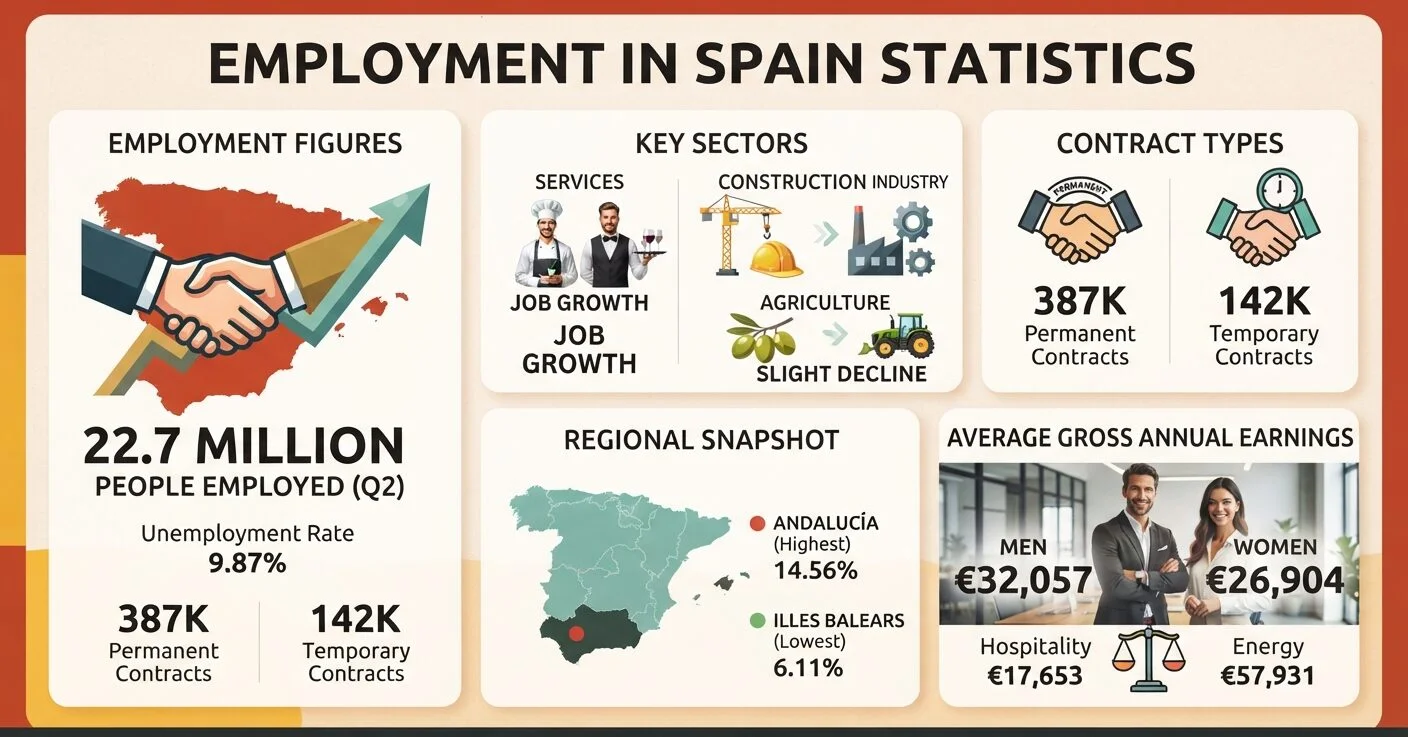
Spain employed 22,779,000 people in the second quarter of 2026 and its unemployment rate fell to 9.87%, according to INE’s Labour Force Survey. These employment in Spain statistics cover quarterly job counts, sector and contract splits, regional unemployment gaps, wages, Social Security affiliation and Spain’s position against the EU. Every figure carries its source and its exact period.
Employment In Spain Statistics
How Many People Are Employed In Spain?
The Labour Force Survey counted 22,779,000 employed people between April and June 2026. Employment rose by 486,000 on the quarter and by 510,200 over twelve months, a 2.29% annual gain.
The survey is not seasonally adjusted, so quarters move on the calendar. Q1 2026 lost 170,300 jobs and Q2 2026 gained 486,000; adjusted for seasonality the Q2 increase was 0.54%.
The labour force grew faster than unemployment fell. Spain added 272,700 active people in the quarter, which is why 486,000 new jobs cut the jobless count by only 213,300. Larger labour markets report the same tension between job gains and participation, as these employment in the United States statistics show.
| Quarter | Employed | Unemployed | Unemployment rate | Labour force |
|---|---|---|---|---|
| Q2 2025 | 22,268,700 | 2,553,100 | 10.29% | 24,821,800 |
| Q3 2025 | 22,387,100 | 2,613,200 | 10.45% | 25,000,300 |
| Q4 2025 | 22,463,300 | 2,477,100 | 9.93% | 24,940,400 |
| Q1 2026 | 22,293,000 | 2,708,600 | 10.83% | 25,001,600 |
| Q2 2026 | 22,779,000 | 2,495,300 | 9.87% | 25,274,300 |
Source: INE, Encuesta de Población Activa, quarterly releases Q2 2025 to Q2 2026
Employment In Spain Statistics By Sector And Contract
Services produced 394,000 of the quarter’s net job gain. Construction added 60,000 and industry 38,200, while agriculture lost 6,200. INE calculates these sector changes on the old CNAE-2009 classification to keep them comparable with earlier quarters.
Employee numbers rose by 529,200 in the quarter. Permanent contracts accounted for 386,900 of that and temporary contracts for 142,300. Randstad Research, analysing the same survey, puts the temporary employment rate at 15.1%, three tenths higher than in Q1 2026.
Self-employment moved the other way, falling by 42,900 over the quarter. That divergence between headline employment and own-account work also appears in these gig economy statistics.
| Category | Change in Q2 2026 | Level in Q2 2026 |
|---|---|---|
| Services | +394,000 | Not published |
| Construction | +60,000 | Not published |
| Industry | +38,200 | Not published |
| Agriculture | -6,200 | Not published |
| Private sector | +501,600 | 19,132,100 |
| Public sector | -15,600 | 3,646,900 |
| Full-time | +405,400 | Not published |
| Part-time | +80,600 | Not published |
Source: INE, Encuesta de Población Activa, Q2 2026 (published 28 July 2026)
Public payrolls shrank by 15,600 while private employment grew by 501,600, so the whole net gain came from the market sector.
Tourism employment
Turespaña counted 3,187,119 people working in tourism activities in Q2 2026, 162,772 more than a year earlier and 14% of total employment in Spain. Unemployment among people active in tourism was 7.5%, half a point below Q2 2025.
Accommodation services grew 9.2% on the year. Travel agencies fell 18.4%, which Turespaña attributes to the CNAE reclassification rather than to actual job losses.
Source: Ministerio de Industria y Turismo (Turespaña), Empleo en turismo, Q2 2026 (published 7 August 2026)
Which Spanish Regions Have The Highest Unemployment?
Illes Balears recorded the lowest unemployment rate in Q2 2026 at 6.11% and Andalucía the highest at 14.56%. The islands added jobs at 18.83% in a single quarter, the largest relative rise in Spain.
Catalonia posted the biggest absolute gain at 130,800 jobs and the biggest fall in unemployment at 92,600. Canarias went the other way, losing 25,100 jobs as its high season ended, with its rate climbing from 11.40% in Q1 2026 to 11.60%.
| Region | Unemployment rate, Q2 2026 |
|---|---|
| Illes Balears | 6.11% |
| Spain (national) | 9.87% |
| Canarias | 11.60% |
| Castilla-La Mancha | 11.81% |
| Extremadura | 13.22% |
| Andalucía | 14.56% |
Source: INE, Encuesta de Población Activa, Q2 2026
The gap between the Balearic rate and the Andalusian rate is 8.45 points. Regional spreads of this width are not unusual in large economies; Canada’s provincial unemployment data shows a comparable range.
What Is The Average Salary In Spain?
Average gross annual earnings reached €29,540.26 per worker in 2024, 5.3% above 2023. The median was €24,497.17 and the most frequent salary €16,520.18, so the mean sits well above what most workers actually earn.
Men averaged €32,057.55 and women €26,904.90, putting female earnings at 83.9% of male earnings. INE notes this gap reflects differences in contract type, working hours, occupation and seniority. Pay disclosure rules are changing across Europe, a shift tracked in these salary transparency statistics.
Hospitality was the lowest-paying activity at €17,653.42. Electricity, gas, steam and air conditioning supply was the highest at €57,931.81.
| Measure | Annual gross earnings, 2024 |
|---|---|
| Mean salary | €29,540.26 |
| Median salary | €24,497.17 |
| Most frequent salary | €16,520.18 |
| Men, mean | €32,057.55 |
| Women, mean | €26,904.90 |
| Hospitality, mean | €17,653.42 |
| Highest region, País Vasco | €35,170.28 |
| Lowest region, Extremadura | €24,979.44 |
Source: INE, Encuesta Anual de Estructura Salarial 2024, definitive data (published 28 May 2026)
Labour costs and the minimum wage
Total labour cost was €3,278.01 per worker per month in Q1 2026, up 4.9% on the year, of which €2,403.80 was wage cost. Employers reported 159,785 unfilled vacancies that quarter.
Cost per hour worked rose 4.8% year on year in Q2 2026, or 4.2% once seasonal and calendar effects are stripped out. That is the twentieth consecutive quarter of annual increases.
Royal Decree 126/2026 set the 2026 statutory minimum wage at €1,221 a month over 14 payments, or €17,094 a year, a 3.1% rise applied retroactively from 1 January. The government estimates around 2.5 million workers are affected.
Source: INE, Encuesta Trimestral de Coste Laboral Q1 2026 and Índice de Coste Laboral Armonizado Q2 2026; BOE, Real Decreto 126/2026
Spain Social Security Affiliation And Registered Unemployment
Average Social Security affiliation was 22,345,226 in August 2026, an annual gain of 679,023 or 3.13%. The raw series lost 162,840 affiliates on the month, while the seasonally adjusted series gained 83,844 and reached 22,371,964, a sixty-seventh consecutive monthly rise.
Foreign nationals accounted for 3,551,759 affiliates, 15.9% of the system and 482,490 more than in August 2025. By 31 August, 337,917 people were registered through the extraordinary regularisation process.
Registered unemployment rose by 44,419 in August to 2,355,918, which the Ministry of Labour describes as the lowest August figure since 2007. It fell in agriculture alone, by 912, and rose in services, construction, industry and among people with no previous job.
| Indicator | August 2026 | Change |
|---|---|---|
| Affiliation, raw series | 22,345,226 | -162,840 on the month, +679,023 on the year |
| Affiliation, seasonally adjusted | 22,371,964 | +83,844 on the month |
| Foreign-national affiliates | 3,551,759 | +482,490 on the year |
| Self-employed affiliates | 3,469,416 | +63,705 on the year |
| Women affiliates | 10,489,342 | +321,186 on the year |
| Registered unemployment | 2,355,918 | +44,419 on the month, -70,593 on the year |
Source: Ministerio de Inclusión, Seguridad Social y Migraciones and SEPE, August 2026 data (published 2 September 2026)
SEPE registered 1,144,827 new contracts in August 2026, of which 440,274 were permanent, or 38.46% of the total. Affiliation at 22.35 million sits below the survey’s 22.78 million because the two count different things: jobs registered with Social Security against people surveyed about work. Neither captures where that work happens, a gap covered in these remote work statistics.
How Do Employment In Spain Statistics Compare With The EU?
Spain’s seasonally adjusted unemployment rate was 10.0% in July 2026, against 6.4% in the euro area and 6.1% across the EU. Only Finland was higher, at 10.5%.
Spanish youth unemployment was 22.9% in July 2026, covering 452,000 people under 25, against an EU rate of 15.1%. The Spanish figure fell half a point from June. Germany’s rate over the same month was 4.0%, detailed further in these employment in Germany statistics.
| Country or area | Unemployment rate, July 2026 | Unemployed persons |
|---|---|---|
| Finland | 10.5% | 302,000 |
| Spain | 10.0% | 2,553,000 |
| France | 8.3% | 2,647,000 |
| Euro area | 6.4% | 11,264,000 |
| EU | 6.1% | 13,516,000 |
| Italy | 5.8% | 1,490,000 |
| Germany | 4.0% | 1,740,000 |
| Czechia | 3.3% | 180,000 |
Source: Eurostat, seasonally adjusted monthly unemployment, July 2026 (published 1 September 2026)
Eurostat’s 10.0% and INE’s 9.87% do not conflict. Eurostat publishes a seasonally adjusted monthly estimate for July; INE publishes an unadjusted quarterly survey covering April to June. Vacancy pressure differs too: the UK counted 711,000 openings in early 2026, a contrast set out in these UK employment statistics, while Spain reported 159,785. Independent workers price against these same national wage floors, as these freelancer statistics illustrate.
FAQs
What is the unemployment rate in Spain in 2026?
Spain’s unemployment rate was 9.87% in the second quarter of 2026, down 0.96 points from Q1, with 2,495,300 people unemployed, according to INE’s Labour Force Survey published on 28 July 2026.
How many people are employed in Spain?
22,779,000 people were employed in Spain in Q2 2026, up 486,000 on the quarter and 510,200 over twelve months. Social Security affiliation averaged 22,345,226 in August 2026.
What is the average salary in Spain?
Average gross annual earnings were €29,540.26 in 2024, up 5.3% on 2023. The median was €24,497.17 and the most frequent salary €16,520.18, per INE’s Annual Structure of Earnings Survey.
Which region of Spain has the highest unemployment?
Andalucía had the highest rate in Q2 2026 at 14.56%, followed by Extremadura at 13.22%. Illes Balears had the lowest at 6.11%, per INE’s Labour Force Survey.
Reddit threads say Spain has the worst unemployment in Europe. Is that accurate?
Not quite. Eurostat put Spain at 10.0% in July 2026, second-highest in the EU behind Finland at 10.5%. Spanish youth unemployment, at 22.9%, ranked below Estonia, Sweden and Finland.
Sources
https://www.ine.es/dyngs/Prensa/EPA2T26.htm
https://www.sepe.es/noticia/SEPE/2026/Septiembre/paro-registrado-sube-agosto-44419-personas
https://ec.europa.eu/eurostat/web/products-euro-indicators/w/3-01092026-bp
