

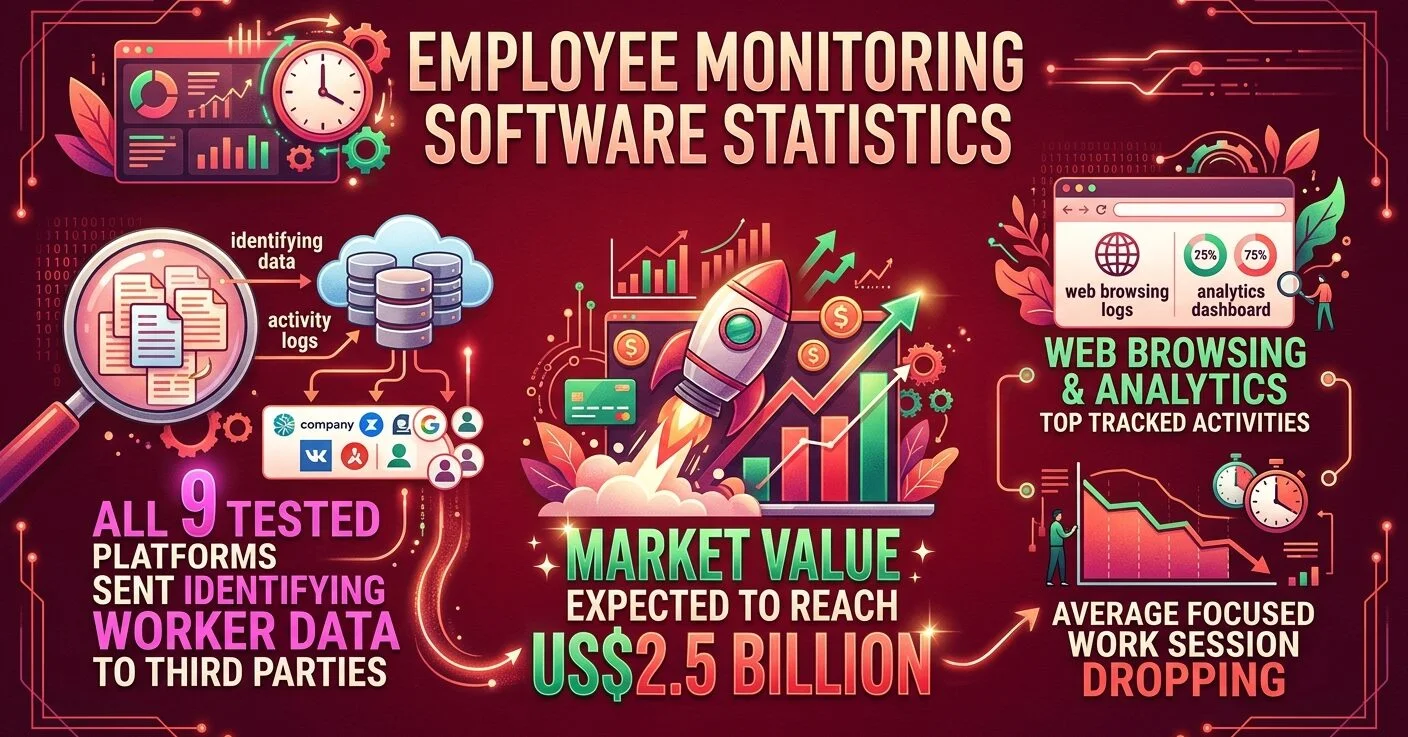
Nine out of nine workplace monitoring platforms tested by university researchers in May 2026 sent identifying worker data to third parties. Persistence Market Research values the wider software category at US$2.5 billion for 2026.
This page collects employee monitoring software statistics on tracked activity, market value, data sharing, logged work patterns and worker reactions, each with its source and period.
Employee Monitoring Software Statistics
What Does Employee Monitoring Software Track at US Employers?
Web browsing logs lead the tracked activities at 62% of US employers. AI-powered productivity analytics follow at 61%, with real-time screen tracking at 59%.
Overall, 74% of employers run at least one online monitoring tool. ExpressVPN fielded the survey through the online sampling service Pollfish in September 2024, covering 1,500 US employers and 1,500 employees.
Physical oversight runs alongside the software. 75% of employers monitor office spaces, using video surveillance (69%) and biometric access controls (58.3%), and 67% collect biometric data.
More than 80% of surveyed companies operate a hybrid model, and 19% are fully remote. Worker-side figures on that model appear in US hybrid work data for 2026.
On disclosure, 86% of employers say they tell staff about their monitoring practices.
US$2.5 Billion: Employee Monitoring Software Market Value for 2026
Persistence Market Research expects the employee surveillance and monitoring software market to reach US$2.5 billion in 2026, per its August 2026 edition. The scope spans software and services, cloud and on-premise deployment, and six monitoring types.
The report lists a historical US1.3billionfor2020andprojectsUS5.8 billion by 2033, a 12.8% CAGR for 2026 to 2033.
Other firms scope the category differently. Market Research Future puts its employee monitoring solution market at US7.035billionfor2025,risingtoaprojectedUS15.98 billion by 2035.
Which Segments and Regions Lead the 2026 Market?
Software holds 72% of the 2026 market and cloud-based deployment 67%. Services are projected to grow fastest among components.
Activity monitoring leads monitoring types at 45%, and IT and telecom leads end users at 28%. Healthcare is the fastest-growing end-user group in the forecast.
North America leads regions at 42%, with the United States making up 85% of that regional share. Asia Pacific is projected to grow fastest.
| Region | Share of 2026 market |
|---|---|
| North America | 42% |
| Europe | 29% |
| Asia Pacific | 23% |
Within Europe, Germany holds 22% of the regional market, the UK 19% and France 14%. India holds 18% of Asia Pacific and Japan 16%.
Northeastern’s 2026 Audit: Where Monitoring Platforms Send Worker Data
Researchers from Northeastern, Columbia, Vanderbilt and UC Berkeley tested nine platforms: Apploye, Deputy, Desklog, Hubstaff, Monitask, Buddy Punch, Time Doctor 2, Vericlock and When I Work. They set up boss and worker accounts and captured what each platform sent to outside parties.
| Finding | Platforms (of 9) |
|---|---|
| Shared identifying worker data (name, email, company) | 9 |
| Shared workers’ online activity data | 9 |
| Can collect location data at any time | 3 |
| Can require motion sensor data to clock in | 3 |
| Named specific third parties in privacy policy or terms | 2 |
Recipients included Facebook, Google, Microsoft and mobile ad platform AppLovin. Activity data reached 145 unique third-party domains, between 14 and 54 per platform.
Browser access produced roughly three times more sharing than mobile apps, at 104 cases against 39. Worker email addresses went to as many as six third parties.
Managers Accounted for 76 of 121 Sharing Instances
The audit counted 121 unique instances of worker data sharing. Cases involving managerial workers made up 76, and non-managerial workers 45.
Only two companies named third parties in public documents, and both lists missed some recipients the testers observed. The other seven named none.
Rules differ by region. Under Article 5(1)(f) of the EU AI Act, AI systems that infer workers’ emotions from biometric data have been prohibited since 2 February 2025.
What Does Employee Monitoring Software Log About the Workday?
| Metric (per employee, per day) | Latest average | Reported change |
|---|---|---|
| Workday length | 8h 44m | −2% (from 8h 53m) |
| Productive hours | 6h 36m | +5% (+19m) |
| Productive session | 27m 30s | +13% (from 24m 25s) |
| Focused session | 13m 7s | −9% (from 14m 23s) |
| Collaboration | 52m | +34% (+13m) |
| Multitasking | 1h 33m | +12% (+10m) |
ActivTrak built the report from 443 million hours of activity logged by its own platform. The data covers 163,638 employees at 1,111 organizations using ActivTrak.
Focused sessions shrank even as productive hours grew, and ActivTrak reports focus time at a three-year low. Interruption counts and meeting load are tracked in workplace distraction statistics.
Weekend activity rose. Saturday productive hours jumped 46% to a 4h 37m daily average, and Sunday productive hours climbed 58%.
Employees in healthy work patterns rose to 75% from 66%, and overutilized employees fell to 7% from 12%. Disengagement risk moved the other way, up to 23% from 19%.
Burnout risk, which ActivTrak defines from logged overutilization, fell 22% to 5% of employees. Survey-based rates use other definitions, covered in employee burnout research for 2026.
AI tools appear in the logs too: 80% of employees use them. Among 10,584 users at 376 companies, email time rose 104% and chat time 145% within 180 days of adopting AI.
49% of US Employees Would Consider Quitting Over More Monitoring
Among US employees, 49% would consider leaving if surveillance increased. That includes 17% who are very likely to resign and 32% who would consider it.
Another 24% would take a pay cut of up to 25% to avoid monitoring. About 44% say surveillance concerns make them hesitant to return to the office, a pressure point in return-to-office versus remote work data.
Awareness lags. Only 22% of employees report knowing they are monitored online, and 50% suspect monitoring without their knowledge.
Employer and employee answers came from separate samples, so the gap with the 86% disclosure rate is indicative. Meanwhile, 69% of employees know surveillance is legal, but 31% are unaware of its full scope at work.
| Source of stress or anxiety | Share of US employees |
|---|---|
| Constantly wondering if I’m being watched | 33% |
| Fear of misinterpretation by monitoring tools | 32% |
| Pressure to work faster rather than thoughtfully | 32% |
| Taking fewer breaks to avoid appearing idle | 24% |
| Privacy concerns over data misuse | 24% |
How Do Workers Fake Activity on Monitoring Software?
About 24% of workers admit to tactics that fake productivity. Keeping unnecessary apps or websites open is the most common, at 16%.
Mouse jigglers and virtual backgrounds each reach 12%. Global disengagement trends sit in quiet quitting statistics for 2026.
How Many UK Organisations Use Employee Monitoring Software?
About a third of UK managers say their organisation monitors staff online activity on employer-owned devices. The Chartered Management Institute polled more than 900 managers in September 2025.
A similar share did not know what tracking their organisation carries out.
| Staff group | Managers reporting online monitoring |
|---|---|
| On-site workers | 36% |
| Hybrid teams | 32% |
| Remote staff | 30% |
Login and logoff tracking is the most common method at 39%. Browser history checks follow at 36%, email content checks at 35% and screen activity recording at 14%.
Managers are split: 53% support monitoring on employer-owned devices and 42% oppose it. Among opponents, 79% say it undermines trust and 58% say it harms morale.
One in six managers would consider looking for a new job if their organisation introduced online monitoring.
FAQs
What percentage of employers use employee monitoring software?
74% of US employers use online monitoring tools, per ExpressVPN’s September 2024 survey of 1,500 employers. In the UK, 36% of managers polled by CMI in September 2025 said their organisation monitors on-site staff online.
How big is the employee monitoring software market in 2026?
Persistence Market Research values the employee surveillance and monitoring software market at US2.5billionin2026,withaprojectedUS5.8 billion by 2033. Firms using other scopes, such as Market Research Future, publish larger totals.
Do employees know when monitoring software tracks them?
Often not. Only 22% of US employees report knowing they are monitored online, and 50% suspect hidden monitoring, per ExpressVPN’s September 2024 survey. In a separate sample, 86% of employers said they disclose monitoring.
Is employee monitoring software legal?
Rules vary by jurisdiction. In the EU, AI systems that infer workers’ emotions from biometric data have been banned since 2 February 2025. In ExpressVPN’s 2024 survey, 69% of US employees knew workplace surveillance is legal.
How many workers use the mouse jigglers discussed on Reddit?
12% of US employees used mouse jigglers or similar devices to look active, per ExpressVPN’s September 2024 survey. Keeping unnecessary apps or websites open was more common, at 16%.
Sources
https://www.expressvpn.com/research/workplace-surveillance-trends-us
https://workplacemonitoring.khoury.northeastern.edu/
https://www.activtrak.com/news/state-of-the-workplace-ai-accelerating-work/
https://www.managers.org.uk/knowledge-and-insights/article/highlights-24-september/
