

A restaurant owner in Stockholm told our team, a few weeks into the SwitchIn project, that she had stopped reading resumes. Not because software read them for her.
Because one opening at her place drew about 120 applications, and roughly seven in ten came from people who had applied to 40 postings that week to keep their unemployment benefits and had not read her job description.
She screened after closing time, at the bar, with the lights half off. Screening was never her problem. What came after it was.
That is the thesis of this piece. Resume screening is the cheap funnel, and AI solved it years ago, badly in some tools and well in others.
The expensive funnel is everything downstream: ranking, matching, the candidate’s experience of being ranked, the feedback loop that tells a model it was wrong, and the short list of decisions no model should make.
I call it the second funnel, and it is where AI changes hiring instead of just speeding up the old version of it.
Screening is the cheap funnel. The second one is where the money leaks
Harvard Business School and Accenture published a two-year study in 2021 called Hidden Workers: Untapped Talent, built on surveys of 2,275 executives and 8,720 hidden workers across the US, UK, and Germany. Its central finding is uncomfortable.
88% of employers said qualified high-skills candidates were being vetted out of the process by their own recruitment software, and the figure rose to 94% for middle-skills roles.
The same report put the number of hidden workers in the US at more than 27 million, and found that companies hiring from that pool were 36% less likely to report talent shortages.
Read that again as a product spec. Nearly nine in ten employers knew their first funnel was throwing away people they wanted. They kept running it, because the alternative (a human reading 120 resumes per opening) was worse.
That is a false-negative problem, and a keyword filter has no fix for it. A filter cannot tell a candidate who lacks a skill from one who spelled it differently.
The second funnel starts where the filter stops. Who gets ranked first. What the applicant sees after hitting submit. Whether anyone replies.
Whether a wrong ranking ever gets corrected. On the hiring products LITSLINK has built, this is where most of the engineering effort goes, and it almost never appears in the RFP.
“AI hiring is keyword matching with extra steps”
AI hiring is resume keyword matching with extra steps. The vendor swaps a Boolean string for a model, charges three times as much, and the same resumes get rejected for the same reasons.
I hear a version of this from skeptical CTOs on most discovery calls, and for plenty of products on the market it is a fair description. It stops being fair the moment a system scores instead of filters.
Take the resume parsing software we built for a global HR technology company that serves staffing agencies in the US and Europe.
The parser pulls fields out of PDFs, Word files, job board exports, and phone photos in twelve languages, with 94% field-level accuracy, trained on about 180,000 hand-labeled resumes.
That part is screening. It replaced seven to nine minutes of manual entry per resume with a 1.8-second median parse. Useful, and not the interesting part.
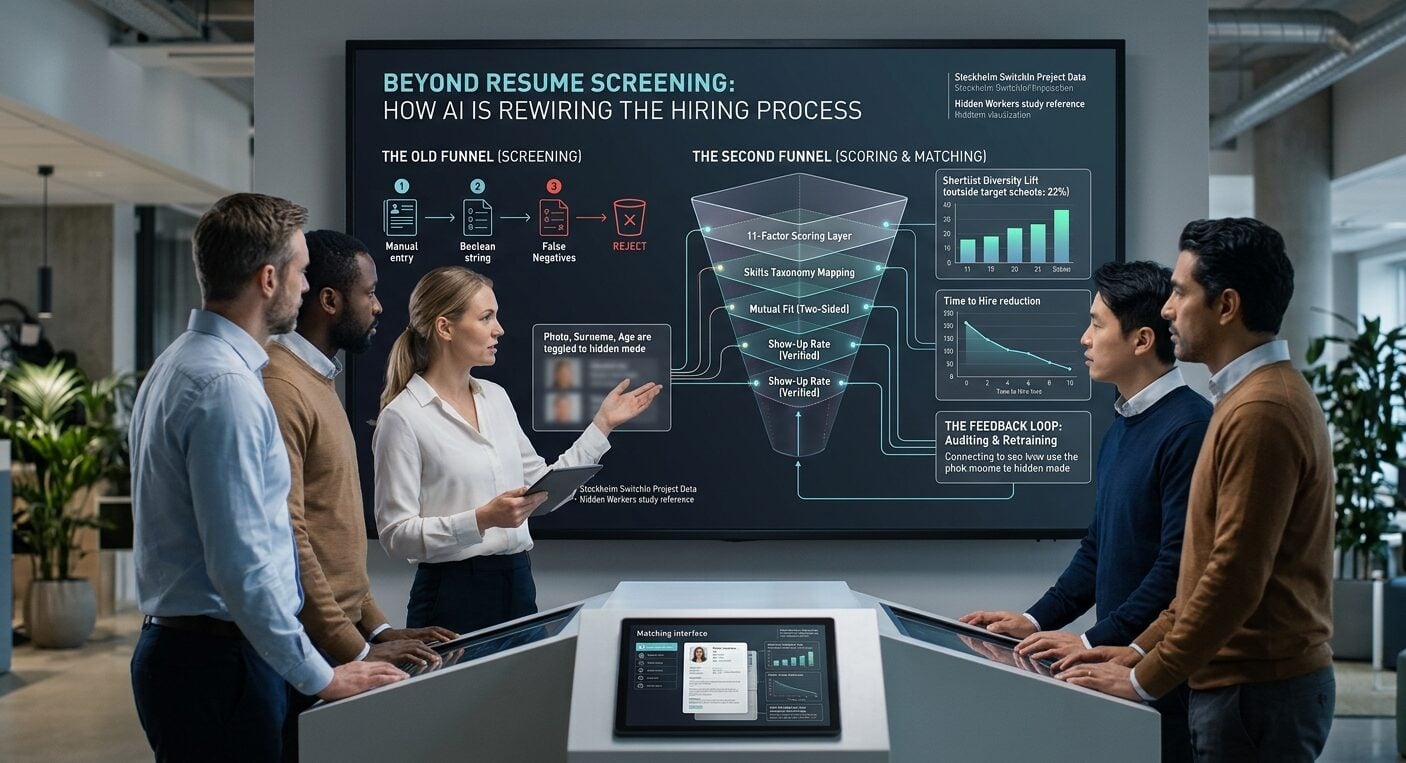
The interesting part is the 11-factor scoring layer behind it, with each factor rated 1 to 5 and a skills taxonomy that maps around 28,000 normalized skills to roughly 140,000 surface variants. “Spelled it differently” stops being a rejection reason.
After the client switched on blind scoring, shortlisted candidates from outside its usual schools and employers rose about 22%. A keyword filter cannot produce that number. It can only produce fewer candidates.
Here is how the three generations of tooling compare once you stop asking “does it read resumes” and start asking what each one is actually trying to maximize.
| Approach | What it optimizes | Typical failure mode | What stays human |
|---|---|---|---|
| Keyword ATS filter | Fewer resumes per recruiter hour | False negatives: qualified people cut for vocabulary, formatting, or a career gap | Everything after the cut, including noticing the cut was wrong |
| Resume parsing plus scoring | Clean structured data and a ranked shortlist | Scoring weights quietly encode the last hiring manager’s habits | Choosing the factors, auditing the weights, running the interview |
| Two-sided matching | Mutual fit, reply speed, show-up rate | Cold start on a thin candidate pool, and applicants gaming the signals | Final selection, the offer, the hard conversation when it fails |
Matching changes what the candidate sees, not only what the recruiter sees
Back to Stockholm. SwitchIn is a Nordic HR tech startup whose founders had hired bar and kitchen staff by hand and wanted a product for owners with no recruiting team.
We spent two weeks in discovery, and the first thing that happened was the founders’ own scoring rules got reweighted, because the original version penalized students. That is a second-funnel decision. No resume had been parsed yet.
What shipped was a relevance score from 0 to 100 built on job requirements, past roles, distance, and shift availability, with unrelated applications pulling the score down. Active profiles sit in memory, so an employer gets a sorted deck for a pool of about 5,000 candidates in under 400 milliseconds.
Photo, surname, and age stay hidden in the employer view until both sides match. Messaging opens only after a mutual match, with calendar slots inside the chat. After interviews, both sides rate each other, and any rating below four stars needs a written reason.
Notice how little of that is about reading a resume. It is about what the applicant experiences. A candidate who gets a reply in three hours instead of never behaves differently, and the pilot numbers show it.
Screening time per opening fell from six to eight hours to about 40 minutes. Time to hire dropped from 26 days to 11. One Stockholm restaurant group ran 14 openings through the pilot and hired 11 people.
The public is not neutral about any of this. Pew Research Center surveyed 11,004 US adults in December 2022 and reported in April 2023 that 66% would not want to apply for a job that uses AI to make hiring decisions.
In the same survey, 47% thought AI would do better than humans at treating all applicants the same way, against 15% who thought it would do worse.
People distrust the black box and trust the consistency. A matching product that hides the photo, scores everyone on the same four inputs, and answers within hours lands on the right side of both numbers.
Feedback loops are the line item nobody budgets for
Every scoring model is wrong on day one, and the only question is whether anyone finds out. On the resume parsing platform, the validation engine flags low-confidence fields for a human, who spends about 12 seconds on each.
A sample of 500 resumes is reviewed every second Thursday. Weekly retraining from recruiter corrections is on the roadmap, not yet in production, and I want to be precise about that because vendors tend to blur the line.
The loop matters more every quarter, because the inputs are getting dirtier. Greenhouse’s 2025 Workforce and Hiring report, published in July 2025 from a poll of 2,200 job seekers in the US, UK, and Ireland, found that 28% of candidates had used AI to generate fake work samples, 47% admitted to embellishing their qualifications, and 22% used bots to apply through traditional hiring systems.
A model trained on 2023 resumes and left alone will score a 2026 applicant pool on signals that no longer mean what they meant.
One connection I will label as my inference rather than something either client claims: I think the 22% jump in shortlisted candidates from outside the usual schools came partly from the correction loop, not only from blind scoring.
Blind scoring removes the school name. The loop is what removes the recruiter’s habit of overriding the score when the name is missing. The case study attributes the lift to blind scoring, and that is the defensible version.
Yevhenii Melikov, a Machine Learning Engineer at LITSLINK who worked on the scoring layer, shared a comment for this piece that I think buyers should hear before they sign anything: “The model does not know what a good hire is.
It knows what your recruiters clicked on last year, and if they clicked on the same three universities, it will learn that and call it relevance.
We can hide the field, but we cannot hide the pattern the field created in the training data. The honest answer is that you have to feed the model outcomes, like who stayed twelve months, and almost nobody has that data clean on day one.”
The numbers that survive a skeptical reading
Put the two projects next to the external research and the pattern holds in every column.
- Manual entry collapsed, and the hours moved into interviews. Recruiters on the parsing platform’s four pilot accounts saved about nine hours a week, shortlist time for one role fell from 35 minutes to six, and interview time per open role rose by roughly a third. Nobody got fired.
- The false-negative rate is the metric that moved the business. Shortlists from outside the usual schools and employers rose about 22% after blind scoring, the same problem the HBS report quantified in 2021 at 88% of employers.
- Two-sided matching fixed behavior, not throughput. SwitchIn’s pilot took no-shows from about one in five to near 6%, first reply time to about three hours, and irrelevant applications per role down 65%. The 58% faster time to hire is a consequence of those three, not a separate feature.
- The inputs are degrading on a known schedule. Greenhouse’s July 2025 data puts AI-generated fake work samples at 28% of candidates. A scoring system without a correction loop is a depreciating asset.
What stays human once the second funnel is automated?
The “AI will replace recruiters” crowd and the “AI is just keyword matching” crowd are wrong in the same direction. Both assume the job is reading. On both projects, the work that stayed with people was never reading in the first place:
- Deciding which factors go into the score, and what weight a career gap or a student schedule gets, before a single model is trained
- Reviewing the flagged fields and the fortnightly 500-resume sample, which is auditing, not data entry
- The interview itself, which got about a third more time per role on the parsing project
- The offer, the counteroffer, and the conversation when a match falls apart after week two
- Owning the bias audit, because the regulator will ask a person, not a vendor
Who builds hiring tooling like this, and what to ask before you sign?
Most companies that hire AI developers for a matching or scoring product are not buying a resume parser, even if that is the line on the invoice.
They are buying a spaCy and PyTorch extraction pipeline, a skills taxonomy, a scoring model, a validation and review workflow, a REST API with OAuth 2.0 that an enterprise security team will sign off on, GDPR deletion support, and a retraining loop fed by recruiter corrections.
LITSLINK has shipped that stack for a platform handling 40,000 documents a day at peak and for a marketplace ranking 5,000 profiles in under 400 milliseconds, and the questions worth asking any vendor are the second-funnel ones: who reviews the flagged fields, how often the model retrains, and what the bias audit looks like.
What to do now?
- Measure your false-negative rate before you buy anything. Pull 200 rejected applications from the last quarter and have two recruiters re-read them blind. If the HBS numbers hold for you, a meaningful share were qualified. That number is your business case, and no vendor demo will give it to you.
- Write the scoring factors yourself, in plain English, before the model exists. SwitchIn’s founders had to reweight their own rules in discovery because they penalized students. Do that work on a whiteboard. It is cheaper there than in a retraining cycle.
- Budget the review loop as a recurring cost, not a launch task. A fortnightly sample of 500 resumes and a person who owns flagged fields is a part-time role. Put it in the headcount plan or the model will drift until a complaint arrives.
- Instrument the candidate side from day one. Reply time, no-show rate, drop-off by stage. SwitchIn’s dashboards tracked swipe-to-interview ratio and drop-off per stage, and those numbers explained the time-to-hire gain better than model accuracy did.
- Hide the fields, then test whether hiding them worked. Blind scoring is a toggle. Proving it changed outcomes is a before-and-after comparison of shortlist composition, which is how the parsing client got its 22% figure. Run the comparison or the toggle is marketing.
The regulators are writing the spec for the second funnel
New York City’s Local Law 144 has required an independent bias audit and candidate notice for automated employment decision tools since July 5, 2023, and it is the clearest signal of where this is heading: the audit obligation sits on the employer using the tool, not the vendor selling it.
The EEOC’s Uniform Guidelines on Employee Selection Procedures date from 1978 and apply to any selection procedure, software included.
Disparate impact analysis is not a new requirement for AI. It is an old one that AI makes easier to violate at scale.
Europe went further and then slowed down. The EU AI Act lists recruitment and selection systems, including tools that “analyse and filter job applications, and to evaluate candidates,” as high-risk under Annex III.
The original compliance date was August 2, 2026. On June 29, 2026, the Council gave final approval to the Digital Omnibus, which pushed the high-risk obligations for stand-alone systems to December 2, 2027.
The classification did not change. Anyone selling into Sweden or Germany with a scoring model should treat the extra 16 months as time to build the audit trail, not time to skip it.
My expectation, and this is a forecast rather than a fact, is that by 2028 the review loop, the hidden-field controls, and the before-and-after shortlist comparison become the documentation a regulator asks for first.
The teams that built the second funnel properly will hand over a folder. The teams that bought a faster keyword filter will hand over an apology.
Screening a resume takes 1.8 seconds now, and everything that matters in hiring happens after that.
