
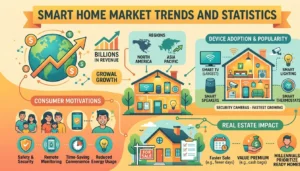






The global smart home market reached $164.13 billion in 2026, up from $147.52 billion in 2025, according to Mordor Intelligence. The United States alone accounts for roughly $54.53 billion of that figure. This article covers the key smart home market trends, device adoption rates, regional breakdowns, and consumer statistics shaping the industry in 2026.
Smart Home Market Statistics 2026
- The global smart home market is valued at $164.13 billion in 2026, projected to reach $311.22 billion by 2031 at a 13.65% CAGR.
- Approximately 77.05 million US homes — roughly 51.37% of all households — are actively using smart home devices.
- Global smart home device shipments are expected to approach 1.25 billion units in 2026.
- Smart home adoption among US and Canadian households rose from 49% in 2024 to 59% in 2025, per the ASHB annual survey.
- Asia Pacific is the fastest-growing region, forecast to expand at a 17.12% CAGR from 2025 to 2031.
How Big Is the Smart Home Market in 2026?
The global smart home market is estimated at $164.13 billion in 2026, according to Mordor Intelligence. Fortune Business Insights places the 2026 figure slightly higher at $180.12 billion, reflecting differences in scope and methodology across research firms.
The US market is projected to reach $54.53 billion in 2026, up from approximately $50.3 billion in 2025. North America holds a 36.23% share of global smart home revenue, supported by 95% household broadband coverage and government incentives tied to energy-efficient home upgrades.
Source: Mordor Intelligence, Fortune Business Insights, rubyhome.com
| Country / Region | 2026 Market Size (USD Billion) |
|---|---|
| United States | $54.53B |
| North America (total) | $56.29B |
| China | $14.34B |
| Germany | $12.72B |
| United Kingdom | $12.29B |
| Japan | $9.15B |
| India | $6.97B |
Source: Fortune Business Insights, Smart Home Market Report 2026–2034
Smart Home Market Growth Over Time
The US smart home market doubled from $15.1 billion in 2017 to $31.5 billion in 2022. It reached approximately $50.3 billion in 2025 and is expected to hit $81.6 billion by 2031, growing at an 8.4% CAGR — a more conservative trajectory than some global forecasts, reflecting the market’s shift from fast early-adopter growth to steadier mainstream expansion.
Globally, analysts at Fortune Business Insights project the market will reach $848.47 billion by 2034 at a 21.40% CAGR. Mordor Intelligence’s estimate is more measured at $311.22 billion by 2031, with CAGR at 13.65%.
Source: rubyhome.com, Fortune Business Insights, Mordor Intelligence
Smart Home Market Statistics by Region
North America leads in current revenue share, but Asia Pacific is expected to outpace every other region in growth rate. China commanded 41.5% of Asia Pacific revenue in 2024. The Asia Pacific market as a whole was valued at $63.17 billion in 2025 and is forecast to reach $193.87 billion by 2030, advancing at a 23.82% CAGR.
Europe’s smart home market is projected to grow from $23.73 billion in 2025 to $32.67 billion by 2030, at a 6.6% CAGR. Germany, France, and the United Kingdom drive most of that growth, with government mandates around smart energy metering playing a key role.
Source: Mordor Intelligence, MarketsandMarkets, Grand View Research
| Region | 2025 Market Share | CAGR (2025–2031) |
|---|---|---|
| North America | 36.23% | ~10–12% |
| Asia Pacific | 28.90% | 17.12% |
| Europe | ~20% | 6.6% |
| Middle East & Africa | ~8% | ~15% |
| Latin America | ~7% | ~12% |
Source: Mordor Intelligence, MarketsandMarkets Smart Home Report 2026–2032
How Many Homes Use Smart Devices in 2026?
In the United States, 77.05 million homes are actively using smart home devices, representing 51.37% of all US households. That figure is expected to rise to 62.9 million dedicated smart homes by 2027, with household penetration climbing from around 43% in 2025 to 46% by 2027, according to Consumer Affairs data citing industry forecasts.
Worldwide, global smart home device shipments are approaching 1.25 billion units in 2026. The total number of active smart home households globally was projected to reach 481.9 million by 2025, according to Statista estimates.
| Year | US Smart Homes (Millions) | US Household Penetration |
|---|---|---|
| 2023 | 55.7M | ~42% |
| 2025 | ~58.4M | 43.3% |
| 2026 | ~77.05M (devices) | ~51.4% |
| 2027 | 62.9M | 46% |
Source: Consumer Affairs, rubyhome.com, Statista
Smart Home Market Demographics
Gen Z and Millennials are the primary drivers of smart home adoption. A CEPRO survey found 96% of Gen Z respondents and 93% of Millennials own at least one smart home device. Among all US smart home users, 65% are under the age of 45, per SQ Magazine data.
Millennials aged 25–34 are the most likely to own multiple devices — 44% of homeowners in that age group have installed three or more smart devices. Households with children under 12 are 1.7 times more likely to adopt voice assistants and smart cameras compared to childless households.
Source: CEPRO “How We Home” Survey, SQ Magazine, scoop.market.us
| Generation | Own At Least One Smart Device |
|---|---|
| Gen Z | 96% |
| Millennials | 93% |
| Gen X | 90% |
| Baby Boomers | 39% |
| Silent Generation | 33% |
Source: scoop.market.us Smart Home Statistics 2026
Most Popular Smart Home Devices in 2026
Smart TVs are the most widely owned smart home device in the United States, present in 58% of households surveyed. Smart speakers follow at 36% penetration, according to CEPRO’s survey. When looking at the global device mix, smart lighting systems lead with 26% of the total device market, followed by security cameras at 23%.
Security solutions remain the top revenue-generating product category in Asia Pacific, holding 29.7% of regional revenue in 2024. Smart security cameras are also the fastest-growing product segment globally, forecast to post an 18.32% CAGR through 2031 as AI-based detection features become standard.
Source: scoop.market.us, CEPRO, Mordor Intelligence
| Device Type | Global Market Share | US Household Ownership |
|---|---|---|
| Smart TVs | 14% | 58% |
| Smart Lighting Systems | 26% | ~31% |
| Security Cameras | 23% | ~25% |
| Smart Speakers | 19% | 36% |
| Smart Thermostats | — | 34% |
| Smart Door Locks | — | 8.2% |
| Others | 18% | — |
Source: scoop.market.us, ASHB 2025 Smart Home Technology Trends Survey, CEPRO
Fastest-Growing Segments
Energy management is the fastest-growing segment by revenue growth rate, projected to expand 77% from 2023 to 2028 in the US market alone, according to Consumer Affairs. Smart security cameras are the fastest-growing individual product category globally at an 18.32% CAGR.
| Segment | Growth Metric |
|---|---|
| Energy Management | 77% growth, 2023–2028 (US) |
| Smart Security Cameras | 18.32% CAGR, 2025–2031 |
| Smart Appliances | 27.4% CAGR in Asia Pacific, 2024–2030 |
| Home Healthcare (Asia Pacific) | Fastest-growing sub-segment, 2025–2030 |
| Smart Lighting | Highest growth rate among device shipments in 2026 |
Source: Consumer Affairs, Mordor Intelligence, Grand View Research
Smart Home Adoption Barriers and Consumer Motivations
Cost remains the leading obstacle for both current and prospective smart home users. The ASHB 2025 survey found 46% of existing smart home owners and 52% of non-adopters cite price as the primary barrier. Setup complexity deters around 28% of each group.
Data privacy is a concern for 26.2% of respondents overall, rising to 43.5% specifically for AI-powered applications. More than half of consumers — 53.8% — say they would be more willing to adopt smart and AI features if vendors provided greater transparency around data use.
| Reason for Using Smart Home Devices | Share of Users |
|---|---|
| Safety and security | 43% |
| Remote monitoring and control | 36% |
| Time-saving / convenience | 34% |
| Increased comfort | 30% |
| Reduced energy usage | 16% |
| “Cool factor” | 8% |
Source: SQ Magazine Smart Home Statistics 2025
Energy Savings and Real Estate Impact
Connected thermostats save households between 10% and 23% on annual heating and cooling costs by learning occupancy patterns and syncing with utility demand-response signals, per US Department of Energy data cited by Mordor Intelligence. The average smart home device generates $546.50 in annual revenue per installed household in the United States.
Smart home features are increasingly factoring into property values. Homes with smart devices sell 8.5 days faster on average than comparable non-smart homes, according to SQ Magazine. Around 35% of real estate agents report smart features add $5,000 to $10,000 in property value, and 78% of first-time home buyers in 2025 said smart home readiness was a major factor in their purchase decision.
| Real Estate Metric | Data Point |
|---|---|
| Faster average sale for smart homes | 8.5 days |
| Value premium reported by real estate agents | $5,000–$10,000 |
| First-time buyers who prioritize smart readiness | 78% |
| Millennial buyers who consider smart homes “essential” | 60% |
| Sellers who add smart upgrades before listing | 22% |
| Homebuyers willing to pay a premium for smart homes | 78% |
Source: SQ Magazine Smart Home Statistics 2025, rubyhome.com
Smart Home E-Commerce and Sales Channels
Online sales now dominate the smart home device market. E-commerce platforms captured 62.52% of all smart home device sales in 2025, according to Mordor Intelligence, reflecting strong consumer demand for DIY installation and direct-to-consumer purchasing.
The indirect sales channel — which includes big-box retailers, telecom bundled offers, and home improvement stores — is forecast to hold 65% of market share by 2035, driven by the continued expansion of retail footprints and carrier-bundled smart home packages.
FAQ
What is the smart home market size in 2026?
The global smart home market is valued at approximately $164 billion to $180 billion in 2026, depending on the research methodology used. Mordor Intelligence places it at $164.13 billion, while Fortune Business Insights estimates $180.12 billion.
Which country has the largest smart home market?
The United States is the world’s largest smart home market, accounting for approximately $54.53 billion in 2026. North America as a whole holds a 36.23% share of global smart home revenue.
What percentage of US homes have smart devices?
Approximately 51.37% of US homes — around 77.05 million households — are actively using at least one smart home device as of 2026, according to rubyhome.com data.
Which generation uses smart home devices the most?
Gen Z leads adoption with 96% ownership of at least one smart device, followed closely by Millennials at 93%. Together, these two generations make up the majority of active smart home users globally.
What is the fastest-growing segment in the smart home market?
Energy management is the fastest-growing segment by revenue growth (77% from 2023 to 2028 in the US). Smart security cameras are the fastest-growing individual product category globally, forecast to grow at an 18.32% CAGR through 2031.


Francesco is a maker, engineer, and 3D printing enthusiast passionate about building tools and spaces that inspire creativity. With a background in software development and hands-on hardware projects, he explores the intersection of digital fabrication, productivity, and modern workspaces. When he’s not designing or experimenting, Francesco shares insights to help others create smarter, more efficient environments for work and making.