




Blooket and Kahoot both turn review sessions into games. Parents reaching for an at-home drill tool, and teachers needing a live classroom quiz, will each reach for a different one. The apps overlap in subject coverage and age range, but they work differently, cost differently, and serve different contexts well.
Blooket vs Kahoot: Core Differences at a Glance
| Feature | Blooket | Kahoot |
|---|---|---|
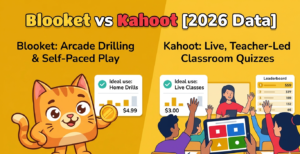
| Ideal use | Home drills and self-paced play | Live, teacher-led class quizzes |
| Quiz options | Pre-built or custom sets | Ready-made or self-created |
| Personalization | Manual | AI-assisted |
| Homework/lessons | No | Yes |
| Free tier | Yes (Starter) | Yes (Basic) |
| Paid plans from | $4.99/month | $3/month |
| Trustpilot rating | 2.9 / 5 | 2.9 / 5 |
What Blooket Does Well
Blooket runs on question sets paired with arcade-style game modes. Pick a set from the community library or write your own, choose a mode, and the game runs immediately. Setup takes under a minute.
For families, this makes joining a Blooket game easy for any age. Homeschool parents and students using it for after-school review both find the rotating modes keep sessions from going stale. Collectible blooks in Blooket give younger students something to work toward.
The main limitation: Blooket tests knowledge but does not teach it. Post-game reports show where a student struggled. Nothing in the app addresses those gaps directly.
What Kahoot Does Better
Kahoot runs on timed, competitive quizzes best suited for groups. A teacher launches a game, students join via Kahoot.it, and the leaderboard updates in real time. The format works well in classrooms because the group energy raises engagement.
Kahoot also supports homework assignments and structured lessons alongside quizzes, which Blooket does not. For teachers who want one tool to handle both review and assigned work, that matters.
At home, Kahoot loses ground. Without classmates competing alongside them, many students disengage. Some parents on Reddit have noted the novelty fades within a few weeks of solo use. Button sensitivity issues and an unclear subscription structure add friction. If you want to explore the paid tier before committing, Kahoot offers a Kahoot free trial to test it out first.
Blooket vs Kahoot Pricing Compared
Kahoot costs less to start, but its plan tiers split across individual, school, and district levels with features that are not always clearly listed at each tier. Blooket’s pricing is simpler. Both offer free access with feature limits.
User Ratings: Blooket vs Kahoot
Both platforms share a 2.9 on Trustpilot. Common complaints across both: they reinforce existing knowledge well but offer little when students hit a genuine gap. Teachers also report that competitive formats can escalate tension in younger classrooms.
Where Blooket and Kahoot Both Fall Short
Neither app replaces instruction. They review content, not teach it. A student who doesn’t understand fractions won’t learn fractions from either platform — they’ll just keep missing the same questions.
Community-generated question sets in Blooket sometimes contain incorrect answers, which frustrated parents and teachers frequently flag in reviews. Kahoot’s question quality is generally higher when using official sets, but user-created content carries the same risk.
If you’re comparing more tools before deciding, the breakdown of Quizizz vs Kahoot vs Quizlet covers three similar platforms side by side.
Blooket vs Kahoot: Which One Should You Pick?
Blooket suits parents and students who want self-paced, game-driven practice at home. The Blooket login process is quick, and the game modes work well for solo sessions. A Blooket Tower Defense strategy guide can help students get more out of the mode-specific gameplay.
Kahoot suits teachers running live sessions where group dynamics push engagement. The assignment and homework features give it a structural edge in formal classroom settings. For a quick game setup, teachers often start by setting up Kahoot with a pre-built kit to save time.
Both platforms are free to try. Start with the context: home practice points to Blooket; classroom-first use points to Kahoot.
FAQs
Is Blooket or Kahoot better for students?
Blooket works better for solo home practice. Kahoot performs better in live classroom settings with a group. The right choice depends on whether the student needs self-paced review or teacher-led competition.
Can you use Blooket and Kahoot for free?
Yes. Both platforms have free tiers. Blooket’s Starter plan and Kahoot’s Basic plan cover core quiz features. Paid plans unlock additional game modes, analytics, and customization options.
Which is cheaper — Blooket or Kahoot?
Kahoot’s paid plans start at $3/month, lower than Blooket’s $4.99/month. However, Kahoot’s tier structure is more complex, and full classroom features require a school or district plan.
Do teachers prefer Blooket or Kahoot?
Many classroom teachers prefer Kahoot for its live quiz format and homework assignment tools. Blooket has a following in homeschool settings and with families looking for after-school review games.
What are the alternatives to Blooket and Kahoot?
Gimkit, Quizizz, and 99math are common alternatives. Gimkit adds in-game economy mechanics, Quizizz supports async homework, and 99math focuses specifically on math drills. Each suits different grade levels and subjects.

